
Australians turn to multiple subscriptions for entertainment

SVOD subscription services continued to grow strongly in 2019 driven by Australians’ love for sports and video entertainment

331.png

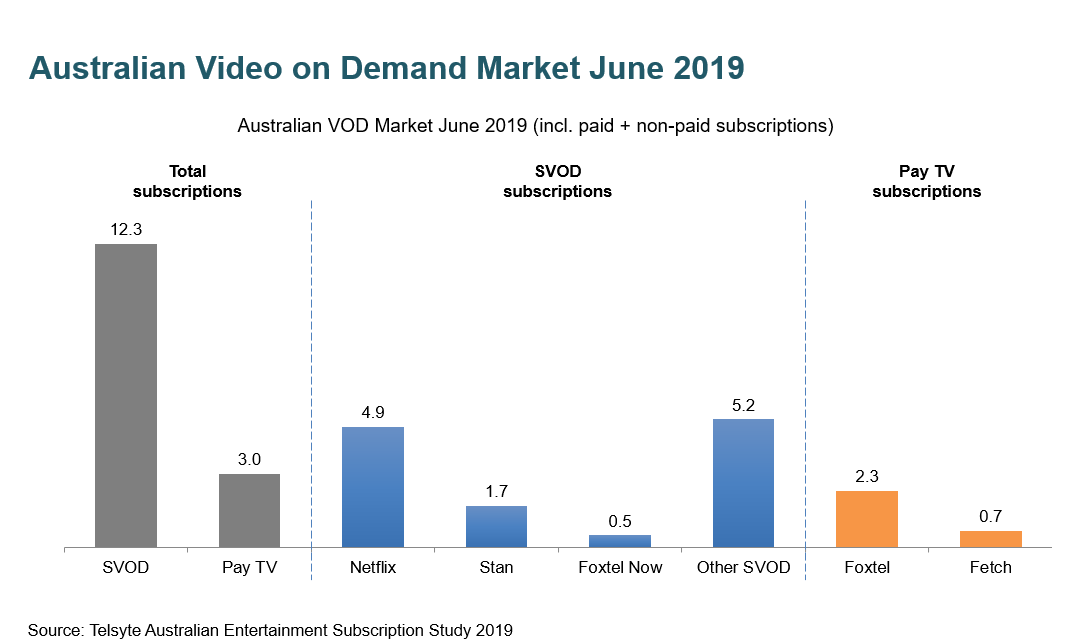
SYDNEY, AUSTRALIA, Australians have a growing taste for sports and video entertainment content sending the Subscription Video on Demand (SVOD) services market to new heights, reaching 12.3 million total subscriptions at the end of June 2019, according to new research from Australian emerging technology analyst firm, Telsyte.

A solid year-on-year increase of 29 per cent has driven subscription up from 9.5 million in June 2018. Today more than half (55%) of Australian households subscribe to SVOD services.

Households continue to show a demand for multiple services , with 43 per cent have more than one SVOD service, up from 30 per cent in 2018. This has steadily been increasing as consumers turn to multiple providers that are battling it out for content rights.

The Telsyte Australian Entertainment Subscription Study 2019 found Netflix is the market leader with around 4.9 million subscriptions and Stan passed the 1.7 million mark at the end of June 2019, remaining the second largest single service provider.

The sports SVOD category saw continued strong demand, driven by adoption of Kayo Sport, Optus Sport and AFL, FFA, Netball and NRL Live passes via Telstra. Telsyte estimates the total “sports” SVOD category (excluding Foxtel Now as it provides a mix of sports and other entertainment content) had around 4.4 million subscriptions at the end of June 2019, up from 3.6 million in June 18, driven by new services and telecom services bundles.

The report found the total Pay TV market maintained just over 3 million subscriptions at the end of June 2019, including cable, satellite and IPTV Fetch TV. Foxtel’s Pay TV segment has been under continued pressure due to increasing adoption of SVOD, including its own base shifting to Foxtel Now and Kayo Sport. Fetch TV remained the growth engine for the Pay TV market.
Entertainment Subscription Study 2019.PNG

New content to maintain growth

Telsyte’s latest consumer survey shows those willing to pay for video subscription services have an average monthly budget of around $30 to cover all their video entertainment needs. The same survey also shows 1 in 3 Australians have no set limit to the number of paid video subscription services they would simultaneously subscribe.

“Subscriptions will be a critical way entertainment and technology brands connect with and monetise their customers,” Telsyte Managing Director, Foad Fadaghi, says.

SVOD services have been proven to be highly sticky in Australia and Telsyte’s latest consumer survey shows nearly half of existing SVOD users believe there will always be enough new content to keep them interested and will not cancel their service, regardless of how many hit TV shows the service has to offer.

Total SVOD subscriptions could reach more than 21 million by the end of June 2023 to meet Australians’ appetite for content. Telsyte believes the demand of existing and new SVOD services will be driven by key content rights during the next 12 to 24 months as more studios and content producers prepare to launch direct services.

Telsyte research shows 1 in 4 Australians (and 37% of existing SVOD users) are interested in subscribing to a potential new a powerful entrant in Disney.

Telsyte research shows there is an opportunity to cross bundle different type of subscription services such as SVOD and streaming music services. Only 1 in 3 Australians subscribe to both SVOD and music streaming services.

Among those do not subscribe to both services, around 1 in 6 would be interested in subscribing to bundled services if it will cost them less to subscribe to the services separately. This might be an opportunity for global players such as Google, Amazon and Apple.

Streaming music continues to grow

As with TV, the streaming music subscriptions market continued to grow steadily driven by service bundles, regular promotions and rapid adoption of smart speakers. Telsyte estimates Australians have taken up more than 12 million streaming music subscriptions at the end of June 2019, with 42 per cent being paid subscriptions.

The top 3 streaming music service providers in Australia remained Spotify, Google (including Google Play Music, YouTube Music and YouTube Premium) and Apple.

Usage of streaming music has just taken over radio time with the average subscriber listening 7.5 hours a week, compared to 7.3 hours for radio. Telsyte forecasts there will be 16.2 million streaming music subscriptions by the end of June 2023.

The availability of very large mobile data caps has been influencing consumer behaviour around radio consumption, facilitating more streaming in car.

Gaming a key subscription market

Telsyte anticipates the gaming market to become the other major entertainment subscription segment alongside streaming video and music subscription services as consumers are becoming more comfortable with the subscription model.

Telsyte research shows Australians have already taken up more than 4 million games related subscriptions at the end of June 2019, consisting of computer and console games subscriptions (such as EA Access and Xbox Game Pass), massively multiplayer online game (MMOG) subscriptions (such as World of Warcraft) and console subscriptions (e.g. PlayStation Plus, Xbox Live Gold).

Telsyte estimates the number of games subscriptions could close to quadruple to more than 16 million by the end of June 2023 with better access to fast Internet connectivity, the arrival of next generation game consoles and new services such as Apple Arcade and Google Stadia that appeal to a broader audience with the ability to play on different devices.

Telsyte research shows around 12.7 million Australians play digital games across devices and more than 8 million play on smartphones alone.

The same research shows 42 per cent of Australians that play games are interested in game subscription services and 1 in 4 are interested in cloud gaming services.

“Game subscriptions have been more focused on consoles and computers, but there are untapped opportunities on mobile with a large base of casual and regular players,” Telsyte Senior Analyst, Alvin Lee, says.

Telsyte expects there will be more than 15 million 5G handsets in use by the end of June 2023, forming the foundation for cloud gaming services adoption.


For further information on the study or media enquiries contact:

Foad Fadaghi

Managing Director

Tel: +61 2 9235 5851

Email: ffadaghi@telsyte.com.au

Alvin Lee
Senior Analyst
Tel: +61 2 9235 5890
Email: alee@telsyte.com.au

The Telsyte Australian Entertainment Subscription Study 2019 is a comprehensive study which provides subscribers with::

  • Market sizing and forecasts of the Australian entertainment subscriptions market, including video, music and games.

  • Key market share data in SVOD, BVOD, Pay TV, Music and games

  • Insights into consumer attitudes and technology adoption trends

  • Uptake, intention and detailed analysis of

    • Video services including: SVOD, pay TV and BVOD services

    • Streaming music services

    • Games subscription services

  • Services consumption preference including devices, fixed and mobile service.

  • Insights into the future of entertainment subscription services in Australia.

In preparing this study, Telsyte used:

  • An online survey conducted in July 2019 with a representative sample of 1,026 respondents, 16 years and older.

  • An online survey conducted in November and December 2018 with a representative sample of 1,025 respondents, 16 years and older.

  • Interviews conducted with executives from media companies, service providers, network operators, content providers, retailers, and hardware manufacturers.

  • Financial reports released by media companies, service providers and network operators.

  • On-going monitoring of local and global market and vendor trends.

About Telsyte

Telsyte is Australia’s leading emerging technology analyst firm. Telsyte analysts deliver market research, insights and advisory into enterprise and consumer technologies. Telsyte is an independent business unit of DXC.technology. For more information visit www.telsyte.com.au

The material in this article is copyright protected and not intended to be altered, copied, distributed or used for any commercial or non-commercial purpose, except for news reporting, comment, criticism, teaching and scholarship.

5G becoming crucial for future business applications

Australian Enterprise 5G market to generate $45 billion by the mid-2020s

suggestion 1 v2.png

The enterprise 5G market in Australia is forecast to generate around $45 billion per annum by the mid-2020s, consisting of next generation application development, IT services, platforms and connectivity, according new research from Australian emerging technology analyst firm, Telsyte

The Telsyte Australian Enterprise IoT & 5G Study 2019 shows more than two thirds (68%) of IT and business leaders already see 5G as crucial for their business strategy going forward. Half of these respondents indicating 5G was critical for future application development, as well as supporting existing applications.

Future applications are expected to make use of the huge data transfer capability, more reliable connectivity and lower latency, which will have the ability to change software architectures, allowing for real-time services and cloud based AI architectures.

The top three barriers to 5G investment cited were integration with current systems (34%), a lack of business case (23%) and security concerns (17%).

Lack of skills is also an issue with more than 25 per cent of respondents indicating they will be looking for an outsourced partner for developing 5G applications.

Enterprise IoT Maturity on the rise

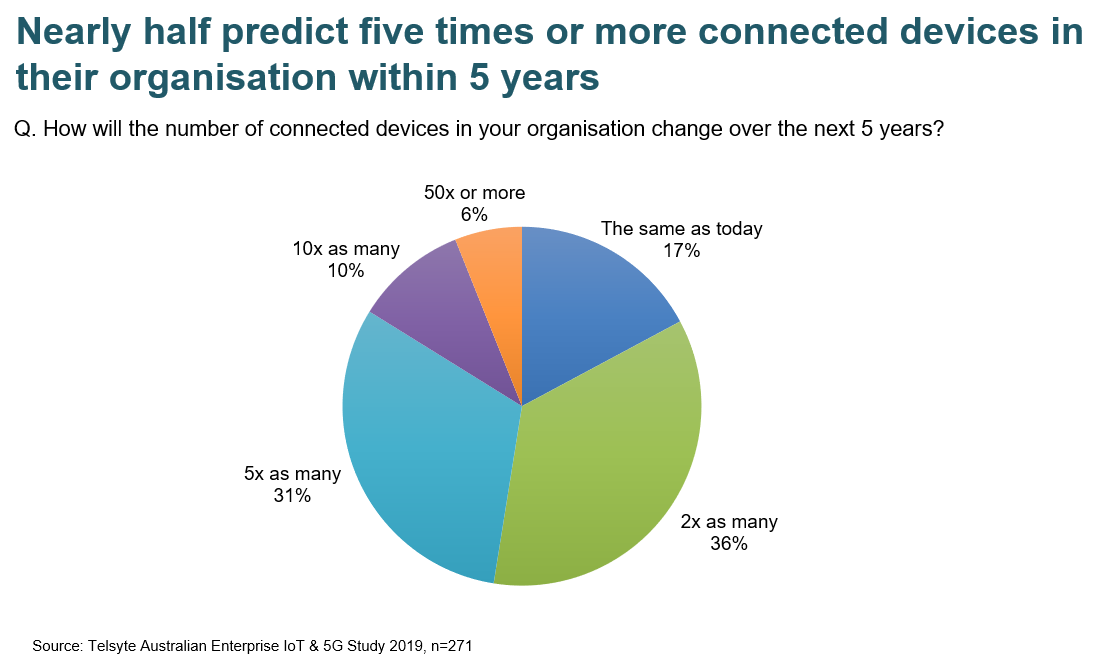
Nearly half of businesses surveyed expect five times or greater connected devices as today within their organisations within five years’ time. This explosion in devices is fuelling innovation and experimentation with “The Internet of Things” (IoT).


Telsyte’s latest Australian Enterprise IoT maturity model shows that 32 per cent of organisations now have a strategic approach to IoT, of which around half have pilot programs running or already have IoT in operations

Among companies that currently do not have a formal IoT strategy, almost 1 in 3 large organisations (200+ employee) plan to adopt an IoT strategy within 12 months.

The biggest barriers are lack of a business case (26%), IoT seen as too expensive (25%) and a lack of skills and expertise (20%). Among those that have overcome the barriers, early signs show that IoT is having a big impact on their businesses.

IoT applications promise big ROI

Enterprise IoT has a diverse range of applications, with the main areas businesses believe IoT will be used in being maintenance (32%), manufacturing (31%) and sales (30%).

Nearly a third (32%) of large firms are also reporting IoT to be suitable for customer service applications.

Of the third of existing businesses that have measured the Return on Investment (ROI) of IoT, 65 per cent claim it increased revenues; half saw an increase in productivity; and, similarly, half realised "better customer satisfaction or advocacy". This closely aligns to the early adopters of IoT which have been in the transport, logistics or asset heavy industries.

Operational cost savings was reported by 39 per cent of organisations, of which around 80 per cent saw nearly a one-third reduction in costs, either through efficiency gains or better management of assets.

Cohesive strategy imperative amid ‘shadow’ IoT

Like its close namesake “shadow IT”, or the spending on IT by non-IT groups in business, enterprises are now facing a wave of “shadow IoT”, where diverse teams are experimenting with connected devices, often unsanctioned or experimental in their nature.

Telsyte research found, one in four companies have IoT capable devices, but no formal strategy around them.

Telsyte research shows that while this approach is growing it does not come without challenges.

A high 81 per cent of companies with shadow IoT are experiencing "stalled" projects.

Other issues such as inconsistent technology selection, poor fit for purpose and higher costs are also experienced by organisations experiencing shadow IoT.

Telsyte Managing Director, Foad Fadaghi, says businesses that are just tinkering with IoT devices are hitting a wall.

"Critical to the success of implementing IoT strategies seems to be taking a scalable and holistic approach, with security considered upfront," Fadaghi says.

The study found more than half of the survey respondents believed that around a quarter of their IoT devices might be connected via cellular technology within 3 years’ time. Around a quarter of organisations believe up to 50 percent could be connected via mobile networks.

For further information on the study or media enquiries contact:

Foad Fadaghi
Managing Director
Tel: +61 2 9235 5851
Email: ffadaghi@telsyte.com.au

Alvin Lee
Senior Analyst
Tel: +61 2 9235 5890
Email: alee@telsyte.com.au

The Telsyte Australian Enterprise IoT & 5G Study 2019 is a comprehensive study which provides subscribers with:

  • Maturity levels, marketing sizing and insights into emerging trends in IoT and 5G

  • Enterprise IoT & 5G trends across enterprise applications, return on investment, cyber security, and 5G outsourcing

  • Australian organisations IT trends and strategies

  • Strategic analysis of market trends and challenges

In preparing this study, Telsyte used:

  • An online survey of 271 IT decision makers across Australian organisations with greater than 20 employees.

  • The respondent was required to have a strong understanding of their organisation’s IT purchasing and strategy, but was not limited to the CIO or IT department

  • Sampling was conducted on a size of spend weighting basis, with 60% of respondents coming from organisations with greater than 200 employees

  • Public information released by service providers, vendors and platforms.

  • On-going monitoring of local and global market and vendor trends

About Telsyte

Telsyte is Australia’s leading emerging technology analyst firm. Telsyte analysts deliver market research, insights and advisory into enterprise and consumer technologies. Telsyte is an independent business unit of DXC.technology. For more information visit www.telsyte.com.au

The material in this article is copyright protected and not intended to be altered, copied, distributed or used for any commercial or non-commercial purpose, except for news reporting, comment, criticism, teaching and scholarship.


Beyond disruption: New Zealand organisations race to digital transformation success

Telsyte has published our latest digital enterprise research study for New Zealand.

suggestion 1.png

Commissioned by DXC.technology, the study provides a comprehensive view on the state of digital disruption and transformation across New Zealand organisations and the wider economy  - the key themes covered in the study include:

  • The impact of digital disruption on New Zealand organisations

  • The approach to digital transformation and non-IT business unit technology spending

  • How the CEO is becoming critical to digital transformation success

  • The role of AI in New Zealand workplaces

  • Factors affecting transformation failure

  • How cloud, 5G, IoT and customer experience technologies drive digital agendas


For further information, please see the following press release by DXC Technology:
https://www.dxc.technology/au/press_releases/146680-dxc_technology_study_finds_new_zealand_businesses_have_less_than_two_years_to_adopt_digital_before_disruption_hits


The full report can be downloaded at:
https://www.dxc.technology/nz/flxwd/146673-beyond_disruption


For further information on the study or media enquiries please contact:

Foad Fadaghi
Managing Director
Tel: +61 2 9235 5851
Email: ffadaghi@telsyte.com.au


 About Telsyte
Telsyte is Australia’s leading emerging technology analyst firm. Telsyte analysts deliver market research, insights and advisory into enterprise and consumer technologies. Telsyte is an independent business unit of DXC.technology. For more information visit www.telsyte.com.au

The material in this article is copyright protected and not intended to be altered, copied, distributed or used for any commercial or non-commercial purpose, except for news reporting, comment, criticism, teaching and scholarship.

Beyond disruption: Australian organisations race to digital transformation success

Telsyte has published our latest digital enterprise research study.


Commissioned by DXC.technology, and built on over a decade of researching the impact of emerging technologies in Australia  - the key themes covered in the study include:


  • How organisations are approaching digital transformation in Australia

  • How the CEO is becoming critical to digital transformation success

  • Impact of AI on jobs and the workplace

  • The growing focus on the customer in digital transformation

  • Measuring benefits of digital transformation

  • Factors affecting transformation failure

  • How 5G, IoT, cloud and customer experience technologies drive digital agendas


For further information, please see the following press release by DXC Technology:
https://www.dxc.technology/au/press_releases/146589-dxc_technology_study_finds_35_000_new_technology_jobs_will_be_needed_to_meet_the_growth_of_digital_transformation_in_australia


The full report can be downloaded at:
https://www.dxc.technology/au/flxwd/146560-beyond_disruption


For further information on the study or media enquiries please contact:

Foad Fadaghi
Managing Director
Tel: +61 2 9235 5851
Email: ffadaghi@telsyte.com.au


 About Telsyte
Telsyte is Australia’s leading emerging technology analyst firm. Telsyte analysts deliver market research, insights and advisory into enterprise and consumer technologies. Telsyte is an independent business unit of DXC.technology. For more information visit www.telsyte.com.au

The material in this article is copyright protected and not intended to be altered, copied, distributed or used for any commercial or non-commercial purpose, except for news reporting, comment, criticism, teaching and scholarship.

Video games driving Australian VR headset sales

Enterprises eye AR for customer facing apps and location services

VR.png

SYDNEY, AUSTRALIA – The Australian VR (Virtual Reality) headset market grew 40 per cent in 2017 to reach 302,000 devices sold, according to new research from emerging technology analyst firm Telsyte.

The Telsyte Australian VR & AR Market Study 2018 found that despite the growth in sales, adoption remains constrained by high device costs, the rapid pace of innovation and lack of clear market winners.

“Australian consumers and developers are taking a wait and see approach to virtual reality” Telsyte Managing Director, Foad Fadaghi says.

Telsyte forecasts that 2.2 million households will have a VR headset in use by 2021, with the main applications being in entertainment. VR headset annual revenue is expected to grow to more than $200 million by 2020, up from $79 million in 2017.

The market leader in VR headsets was Sony PlayStation, which benefited from selling VR as an accessory for the PlayStation 4, and its ability to attract leading games publishers. Sony PlayStation has announced over 50 new VR games titles for 2018.

As awareness has advanced, health concerns surrounding VR has plummeted, with only 5 per cent of survey respondents concerned about negative health implications of VR, down from 36 per cent in 2016.

 Augmented reality gets smartphone boost

 Telsyte believes with more use cases and higher levels of accessibility, augmented realty (AR) – or the overlaying of computer-generated digital images over a camera feed of the real world on devices such as smartphones, tablets, and headsets  is expected to gain broader adoption than VR. The popular AR apps such as Pokémon GO and Snapchat photo filers have helped rocket AR into the mainstream, with 1 in 3 of Australians saying they have tried AR applications.

Telsyte research shows that 67 per cent of iPhones used in Australia are ARKit compatible (Apple’s AR development platform), and 23 per cent of Android phones are AR core compatible (Google’s AR development platform).

While most AR applications are currently being developed for smartphones and tablets, Telsyte forecasts that consumer AR headsets and smart glasses will be commercially available towards the end of 2020, some combining AR and VR functionality.

AR chart.png

Training and design ripe for Enterprise VR

Around one third of organisations interviewed by Telsyte indicated they are either investigating or implementing VR applications. Driving this intention was applications in education & training (40%) and product design & engineering (38%). 

Interest in VR applications for education and training is most prevalent in the professional, scientific and technical services organisations.

Lack of knowledge in VR and lack of skills in app development are key barriers to enterprise adoption, which is further complicated by the numerous VR platforms currently battling for dominance.

 Enterprise AR set to boom

Enterprise interest in AR is higher than VR with 46 percent of organisations currently investigating or implementing AR applications. Customer facing applications (40%), location-based services (38%) and project management (37%) are the main applications being developed.

Most organisations building AR apps are developing for the iPhone (74%), followed by iPad (64%) and Android smartphones (64%).

Like VR, lack of skills and technology maturity are the key barriers for AR with almost 1 in 3 organisations identifying both as barriers.

“With a large established installed base of AR capable smartphones and tablets, AR is becoming the go to option for businesses that are experimenting with immersive technologies” Fadaghi says.

For further information on the report or media enquiries contact:

Foad Fadaghi
Managing Director
Tel: +61 2 9235 5851
Email: ffadaghi@telsyte.com.au

Telsyte’s Australian VR & AR Market Study 2018 is the fourth edition in a comprehensive study which provides subscribers:

  • Market sizing and forecasts of the Australian virtual reality market

  • Australians attitudes to VR & AR software and hardware

  • Enterprise VR & AR adoption and use cases in Australian organisations

  • Analysis of current offerings in the market, and strategic issues for developers

  • End-user trends and intentions.

In preparing this study, Telsyte used:

  • Interviews conducted with executives from VR/AR vendors, retailers, software developers, game publishers and channel partners.

  • An online survey of a representative sample of Australians 16+ years of age conducted with 1,162 respondents in November 2017.

  • An online survey of a representative sample of technology decision makers across Australian organisations with greater than 20 employees, around half in companies with greater than 200 employees

  • On-going monitoring of local and global market and vendor trends.

  • Financial reports released by hardware and software vendors .

About Telsyte

Telsyte is Australia’s leading emerging technology analyst firm. Telsyte analysts deliver market research, insights and advisory into enterprise and consumer technologies. Telsyte is an independent business unit of DXC.technology. For more information visit www.telsyte.com.au

The material in this article is copyright protected and not intended to be altered, copied, distributed or used for any commercial or non-commercial purpose, except for news reporting, comment, criticism, teaching and scholarship.