
Extended Reality (xR) market poised for growth

Apple’s headset could bring ‘X-factor’ for xR adoption

SYDNEY, AUSTRALIA – The launch of an Apple headset and the development of Extended Reality (xR) technology could boost the uptake of head-wearable devices in Australia, as consumers seek new ways to enhance their lifestyles, health and entertainment, according to new research from Telsyte, an Australian emerging technology analyst firm.

The Telsyte Australian Smartphone & Wearable Devices Market Study 2023 found that smart wearables grew in popularity with smart wrist and ear devices growing in adoption, with 36 per cent and 29 per cent population penetration respectively.


However, Telsyte expects head devices (headsets and glasses) to gain momentum with new powerful xR chipsets, partnerships such as the Qualcomm, Google and Samsung alliance, new and improved applications (for productivity, fitness and education) and highly anticipated products and games in 2023.

The xR market has been driven largely by enterprises, gamers and tech enthusiasts so far, but Telsyte’s consumer survey shows that more than one in four (27%) Australians are enthusiastic about its possibilities. This is three times that amount of individuals that are current adopters, about 1.5 million (6%) Australians at the end of 2022, a small rise of 4 per cent rise over the previous year.

Those interested in xR are drawn to various applications, especially entertainment, including games (38%), virtual tours (33%) and videos (31%). Sports, health and fitness applications also appeal to more than 1 in 5 (22%) consumers.

Manufactures have for years grappled with the balance between weight, tethering, comfort, and safety. The survey also showed that the majority (91%) of Australians prefer a wireless headset that works without cables. Telsyte believes battery life limitations are still a major impediment to smart headset adoption, especially for longer usage scenarios such as gaming and long-format video. This echoes the sentiment for wrist wearables, where battery life has been rated the most important selection criterion in the last two years.

The wearability of xR devices is another key factor vendors have been focusing on, with better weight and design optimisation. When selecting an xR headset, survey respondents say comfort and wearability measures are important to them, such as fitting of the headset (62%), weight (60%) and the ability to adjust lenses for their prescriptions (50%).

In addition to a “preference for real-world interactions”, the research found that those who are not interested in xR technology cite a lack of games and apps (24%), and the lack of interest among their friends and families (19%).

Apple could be a game-changer for xR adoption with a loyal user base and hungry developer ecosystem

Telsyte believes the potential release of Apple’s xR headset could accelerate the adoption of head wearables, alongside other new xR headsets, such as HTC’s VIVE XR Elite and Meta’s Quest Pro.

More than half (57%) of Australians aged 16 and older are already familiar with the Apple ecosystem and use different Apple devices and services that could complement and enhance the overall experience of an Apple headset.

Apple has a proven track record of attracting app developers and introducing successful new platforms. Telsyte’s latest measure found 37 per cent of Australian Apple users are considered loyal (using five or more different Apple products and services), up from 20 per cent two years ago.

Telsyte believes that this loyal base, which tends to buy more Apple devices and services, will be the early supporters of Apple’s ambitions in immersive technologies.

Apple is also well positioned to attract app developers to any new device category. Telsyte estimates that Apple’s App Store already has more than 140,000 AR apps for its iPhones and iPads, which could work with a xR headset at launch or soon after.

Those keen on xR are willing to pay an average of $733 for a headset, with 20 per cent ready to pay over $1,000. However, the Apple headset is expected to be significantly more expensive and designed initially for developers.

If Apple only releases a developer headset model in 2023, Telsyte estimates that it could sell between 10,000 and 40,000 units in Australia in the first year, depending on availability, price and the appeal to new enthusiasts. Telsyte expects Apple to follow up with a more affordable version, suited to smaller budgets as early as 2024, which could take off.

Telsyte forecasts the number of Australians using an xR headset could more than double to 3.3 million (12%) by 2027 based on scenario analysis.

“Introducing a new wearable device platform in 2023 would help energise Apple’s loyal developers,” says Foad Fadaghi, Principal Analyst and Managing Director at Telsyte.

“The key factor to Apple’s success or failure in xR will be third-party developers and application monetisation” Fadaghi says.

Extended Reality - xR is the collective term used to describe various immersive technologies including virtual reality (VR), augmented reality (AR), and mixed reality (MR).


For further information on the study or media enquiries contact:

Foad Fadaghi
Managing Director
Tel: 1800 313 142
Email: ffadaghi@telsyte.com.au

Alvin Lee
Senior Analyst
Tel: 1800 313 142
Email: alee@telsyte.com.au

The Telsyte Australian Smartphone & Wearable Devices Market Study 2023 is a comprehensive study that provides subscribers with:

  • Smartphone market sizing estimates, platform and vendor market shares and forecasts

  • Smart wrist-based wearables market sizing estimates, platform and vendor market shares and forecasts

  • Smart hearables market sizing estimates, platform and vendor market shares and forecasts

  • xR headset market sizing estimates and forecasts

  • End user trends across devices, application usage, platforms and operators

  • Purchase intentions and acquisition channels

  • Strategic analysis of recent market trends and developments

Telsyte measures smart wearable devices in the Telsyte Australian Smartphone & Wearable Devices Market Study 2023 as computing accessories:

  • Smart wrist wearables: worn on a user’s wrist typically paired and controlled via a smartphone. Examples includes products from Apple, Asus, Fitbit, Fossil, Garmin, Huawei, iFit, Misfit, Oppo, Samsung, Skagen, SPACETALK, TomTom, Withings and others.

  • Smart hearables: smart earbuds and headphones that support digital assistants and are typically paired with a smartphone. Examples include Apple Airpods, Samsung Galaxy Buds, Microsoft Surface Headphone and Google Pixel Buds.

  • xR headsets: VR, AR or MR headsets such as HTC Vive XR Elite, Meta Quest Pro, Microsoft Hololens, Pico 4, Sony PlayStation VR 2 and Steam Valve Index.

In preparing this study, Telsyte used:

  • Telsyte’s annual Digital Consumer survey conducted during January 2023 with a representative sample of 1,036 respondents, 16 years and older.

  • Interviews conducted with executives from service providers, network operators, manufacturers, retailers, financial analysts and channel partners.

  • Financial reports released by service providers, manufacturers and retailers.

  • Ongoing monitoring of local and global market and vendor trends.

  • Analyst reviews of leading smartphone and wearable devices.

Editor’s note:

Telsyte measures sales of devices (“sell out”), not shipments or sales to retailers or carriers (sometimes called “sell-in”). Telsyte believes this is a more accurate measure of performance of products in a marketplace. Telsyte does not rely on disclosure from vendors or general assumptions made for large multinational companies that do not release local market data. Telsyte uses a comprehensive methodology that includes surveys of consumers, discussions with vendors, carriers and their partners, retailers, and financial analysts. In addition, public financial results from manufacturers and carriers are used.  Telsyte tests a wide range of products in real life usage scenarios and conducts satisfaction and repeat purchase surveys with large and representative samples of Australian smart device users. Telsyte is a pioneer in measuring and reporting smartphone sales in Australia and has been providing insights on mobile technologies since 2006.

Telsyte currently covers head wearables from HP, HTC, Lenovo, Magic Leap, Meta (Oculus), Microsoft, Pico, Sony, Vajor, Valve and others.

About Telsyte

Telsyte is Australia’s leading emerging technology analyst firm. Telsyte analysts deliver market research, insights and advisory into enterprise and consumer technologies. Telsyte is an independent business unit of DXC Technology. For more information visit www.telsyte.com.au

The material in this article is copyright protected and not intended to be altered, copied, distributed or used for any commercial or non-commercial purpose, except for news reporting, comment, criticism, teaching and scholarship.

Generative AI set to change the way Australians live and work

One million Australians were already using ChatGPT in January 2023

SYDNEY, AUSTRALIA – Australians are showing strong interest and rapidly adopting new Generative AI applications such as Open AI’s ChatGPT, according to new research from the Australian emerging technology analyst firm, Telsyte.

One in five Australians aged 16 and older were already aware of ChatGPT, and one million Australians were already using it according to a survey conducted by Telsyte in mid-January 2023, just a month and a half since the release of ChatGPT.

The study also found that one in three (34%) Australians is already interested in using Generative AI chatbots like ChatGPT for various tasks such as language translation (44%), brainstorming ideas (34%), summarising long documents (33%), and helping with research (27%). The intention rises to 49 per cent among young Australians aged 18 to 34s.

With many learning and discovering the potential of Generative AI, the research also found that 33 per cent of the Australian workforce interested in the technology intends to use it for work.

However, the study also reveals some challenges and risks associated with Generative AI. Nearly half (49%) of Australians anticipate significant changes to the workforce and job requirements in the future due to the growing prevalence of AI-based machines and software.

Only 29 per cent of the current workforce is willing to train machines or software to take over part of their own work, as well as part of someone else’s work (29%).

A workforce that could look very different in 10 years’ time because of AI

The Australian workforce is preparing for a future workplace that might look very different in a decade. In fact, 35 per cent of workers already expect that machines, AI, or robots could perform their roles in the future.

Of those who think machines could do their roles, 42 per cent think part of their roles will be replaced in five years, while a staggering 71 per cent think this will happen in 10 years.

When asked about the possibility of their roles being fully taken over by machines or AI, 30 per cent of the workforce think this could happen in a decade. This figure rises to 57 per cent when the timeframe is extended to 20 years.

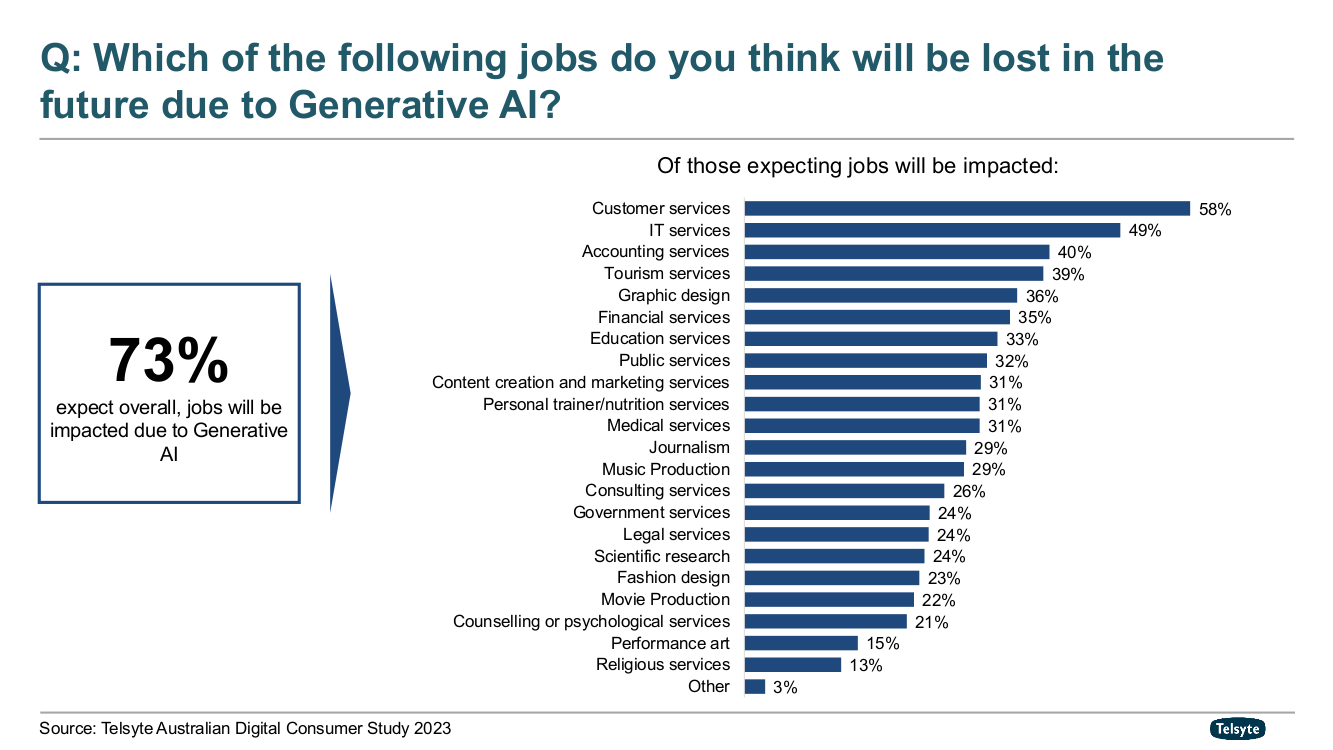
Overall, almost three-quarters (73%) of Australians anticipate future jobs will be affected by Generative AI. The top perceived roles include customer services (58%), IT services (49%) accounting services (40%), tourism (39%) and graphic design (36%).


“The Australian workforce want to reduce the workload, but are wary AI might replace them”, says Foad Fadaghi, Principal Analyst and Managing Director at Telsyte.

“Generative AI has the potential to transform many industries and sectors, but it also poses some ethical and social implications that need to be carefully considered and addressed,” says Foad Fadaghi.

Incoming AI-as-a-Service

As generative AI models and APIs become more accessible and versatile, Telsyte anticipates that more paid AI assistance services like ChatGPT Plus will emerge in 2023.

The study revealed that 9 per cent of Australians would pay for AI assistance subscriptions to assist them with their daily tasks and queries, especially those aged 25 to 34s (15%) and those working in the professional (16%) and education (16%) sectors.

On average, those who would pay for AI subscriptions are willing to spend around just under $10 per month. However, 37 per cent of respondents would pay over $10 per month, suggesting a potential market for prosumer applications.

For further information on the study or media enquiries contact:

Foad Fadaghi
Managing Director
Tel: 1800 313 142
Email: ffadaghi@telsyte.com.au

Alvin Lee
Senior Analyst
Tel: 1800 313 142
Email: alee@telsyte.com.au

The Telsyte Australian Digital Consumer Study 2023 is a comprehensive study that provides subscribers with analyst content and services covering:

  • Key technology, services and lifestyle trends

  • Adoption and 4-year forecast of personal technologies (e.g. smartphones, smartwatches, tablets, 2-in-1s, computers, XR headsets, etc)

  • Adoption and 4-year forecast of household technologies (e.g., smart speakers, smart TVs, gaming consoles, Chromecast, Amazon Fire TV, Apple TV and other set-top boxes, etc)

  • Generative AI and other AI/automation applications

  • Post-PC device preferences and intentions

  • Wearable technology preferences and intentions

  • NBN, 5G and broadband

  • Mobile services

  • Digital video, Pay TV, Streaming video, television (including broadcast video on demand)

  • Social media

  • Technology, social and online apps adoption amongst children under 18s

  • Digital services and gig economy

  • Digital payments, banking and eCommerce trends

  • Interactive games and cloud gaming

  • Cybersecurity, privacy and consumer cloud

  • Attitudes to lifestyle and technology

In preparing this study, Telsyte used:

  • Telsyte’s annual Digital Consumer survey conducted during January 2023 with a representative sample of 1,036 respondents, 16 years and older.

  • Interviews with executives from service providers, network operators, manufacturers, retailers, financial analysts and channel partners.

  • Financial reports released by service providers, manufacturers and retailers.

  • On-going monitoring of local and global market and vendor trends.

About Telsyte

Telsyte is Australia’s leading emerging technology analyst firm. Telsyte analysts deliver market research, insights and advisory into enterprise and consumer technologies. Telsyte is an independent business unit of DXC Technology. For more information visit www.telsyte.com.au

The material in this article is copyright protected and not intended to be altered, copied, distributed or used for any commercial or non-commercial purpose, except for news reporting, comment, criticism, teaching and scholarship.

Mobile services bouncing back as handhelds return to growth

Australian MVNOs set to benefit as price hikes loom

SYDNEY, AUSTRALIA – Australia’s mobile services market turned a corner with handheld Services in Operations (SIOs) returning to growth for the first time since the start of the pandemic, according to new research by emerging technology analyst firm Telsyte.

The Telsyte Australian Mobile Services Market Study 2022 tracks SIOs (Services in Operation) in mobile handsets, mobile broadband and mobile IoT for business applications.

The study found the total number of mobile SIOs grew 696,000 (1.9%) to 37 million during the six months to December 2021, with handheld SIOs adding 271,000 connections.

The market recovery follows a handheld segment decline of 1.1 million SIOs during the 18 months between January 2020 and June 2021, as a result of closed international borders and stalling population growth.

Telstra had the highest mobile SIO growth during the 6-month period, followed by MVNO (Mobile Virtual Network Operators). Telstra’s net increase in SIOs was primarily driven by mobile IoT for businesses.

However, if mobile IoT is excluded from the total measurement, MVNOs outperformed the rest of the market because of more competitive mobile plans and offerings.

MVNOs leading the recovery


MVNOs now make up 17 per cent of the total SIOs as of the end of December 2021, up from 14 per cent in 2019 (just before the COVID-19 pandemic) and more than tripled in the last 10 years.

A third of the MVNO market is now made up of carrier sub-brands such as Amaysim and Belong. Telsyte believes the multi-brand strategy has become increasingly critical to the carriers’ ability to compete in more price-sensitive segments.

Telstra’s recent announcement of mobile plan price increases, in line with the CPI (Consumer Price Index), signals that low-price sub-brands might be even more critical to the carriers in the next few years.

Telsyte estimates up to one in six mobile service users could be looking at switching providers in 2022 with MVNOs likely to most benefit.

The study found 32 per cent of those thinking of changing their service provider said their current plan was too expensive. Network performance factors including coverage and reliability make up the top three churn factors.

5G, eSIMs gather pace

Telsyte estimates there were six million 5G mobile services in operation at the end of December 2021, a near three-fold jump from a year ago. This was mainly due to the increased availability of 5G handsets in the sub-$600 price range.

Consumers are eyeing 5G with two in five (39%) Australians regarding 5G access as important when choosing a service provider.

Australian 5G mobile users, on average, are using 43 per cent more data than those on 4G. However, the study also found 5G users are yet to take advantage of their larger data allowances and have lower data utilisation compared to 4G (20% on 5G vs. 27% on 4G).

Telsyte expects handset upgrades will continue to ramp up 5G uptake with around 60 per cent of SIOs expected to be on 5G by 2025 (currently at 16%).

In another boost for the market, the availability of eSIMs devices is reaching mainstream levels with 35 per cent of smartphones in use already supporting eSIMs.

“eSIMs are increasingly strategic to service providers for improving customer experience, sustainability and supporting new connected devices” Telsyte Senior Analyst, Alvin Lee, says.

Telsyte anticipates more providers will become ‘eSIM-ready’ later this year as the carriers expand eSIM support to their MVNO partners.

Currently less than one in ten eSIM-capable smartphones are utilising the feature as support is still limited to the main carriers and Felix Mobile, Gomo, Kogan Mobile, Lebara, and Woolworth Mobile.

For further information on the study or media enquiries contact:

Foad Fadaghi
Managing Director
Tel: 1800 313 142
Email: ffadaghi@telsyte.com.au

Alvin Lee
Senior Analyst
Tel: 1800 313 142
Email: alee@telsyte.com.au

The Telsyte Australian Mobile Services Market Study 2022 is a comprehensive study that provides subscribers with:

  • Market sizing and forecasts of the Australian mobile services market

  • Analysis of market share and carrier performance

  • End user trends across devices, application usage, platforms, channels and accessories

  • Tablet and computer purchase intentions and loyalty

  • Tablet audience estimates

  • Strategic analysis of market trends and issues

In preparing this study, Telsyte used:

  • Telsyte’s annual Digital Consumer survey conducted during December 2021 and 1st week of January 2022 with a representative sample of 1,114 respondents, 16 years and older.

  • Interviews conducted with executives from service providers, network operators, manufacturers, retailers, financial analysts and channel partners.

  • Financial reports released by service providers, manufacturers and retailers.

  • On-going monitoring of local and global market and vendor trends.

  • Analyst reviews of leading tablet and computer devices.

About Telsyte

Telsyte is Australia’s leading emerging technology analyst firm. Telsyte analysts deliver market research, insights and advisory into enterprise and consumer technologies. Telsyte is an independent business unit of DXC Technology. For more information visit www.telsyte.com.au

The material in this article is copyright protected and not intended to be altered, copied, distributed or used for any commercial or non-commercial purpose, except for news reporting, comment, criticism, teaching and scholarship.

Apple Silicon boosts Mac sales

Tablet and computer sales cooling after pandemic boost

SYDNEY, AUSTRALIA – Australian’s interest in Apple silicon computers and tablets are helping it gain market share, according to new research by emerging technology analyst firm Telsyte.

The Telsyte Australian Tablet Computer Study 2022 found that more than one in three (36%) Australians planning to purchase a computer in 2022 are considering Apple Silicon M1 devices.

First released in 2020 on Macs, the M1 also features in iPads and The Telsyte Australian Tablet Computer Study 2022 found that close to one in four (23%) iPads sold in 2021 contained the high-performance M1 chip.

Despite having an ARM version, Telsyte estimates less than 5 per cent of Windows compatible computers sold in 2021 featured an ARM processor, but this could increase substantially over the next two years. The advantage of better battery life and portability will appeal to businesses as Microsoft is set to follow Apple down the ARM path with recent announcements

With further software and app improvements to iPads to take full advantage of the M1 chips, Apple could introduce native Pro Mac apps like Final Cut and Logic for iPad Pros or develop a mode that allows iPads to run apps more like MacOS in coming WWDC announcements.

Tablet and computer sales soften as Macs and Chromebooks shine


The study found tablet and computer sales softened in 2021 with some 3.4 million tablets and 4.0 million computers sold. This was up 1.4 per cent and down 2.3 per cent respectively from a year ago. However, both figures are still higher than pre-pandemic levels.

The standout performance within the computer market includes Apple Mac computers and Chromebooks (although from a much smaller base), both grew strongly by 17 per cent and 15 per cent respectively.

According to Telsyte’s research, Apple remained the leading vendor in the tablet market with more than half of tablets sold in 2021 being iPads (iPads 53.6%, Android 16.0%, Windows 28.5%, ChromeOS 2.0%) and sales of iPads and Chromebook 2-in-1s grew by 5 per cent and 8 per cent respectively, while the other operating systems have experienced a decline in sales (3% and 2% respectively).

The top three tablet vendors in 2021 remained Apple, Samsung and Microsoft, with over 80 per cent of total sales combined.

Google’s Android and ChromeOS set for a surge

Google has two consumer operating systems – Android and ChromeOS – and affordable Chromebooks are starting to appeal to consumers beyond the education sector.

Telsyte’s research found the growing popularity of Chromebooks (both the 2-in-1 and laptop form factors) is making them increasingly competitive in both the tablet and computers markets, as an affordable computing device that also offers the full desktop web browsing experience.

The study found Lenovo is the leading Chromebook vendor in both the tablet (2-in-1) and computer markets.

Despite easing consumer demand for Android tablets, Telsyte expects Google’s refocus on Android tablets – with better software support from Android 13 – could improve productivity and potentially lift consumer and developer interest.

Android 13 is expected to have further user interface optimisation and gestures to take advantage of larger screens.

According to the study, 2-in-1s continued to dominate tablet sales with over 80 per cent of tablets sold in 2021 being 2-in-1s. Keyboard attachment rates continued to increase across all tablet operating systems, including Android tablets.

For further information on the study or media enquiries contact:

Foad Fadaghi
Managing Director
Tel: 1800 313 142
Email: ffadaghi@telsyte.com.au

Alvin Lee
Senior Analyst
Tel: 1800 313 142
Email: alee@telsyte.com.au

The Telsyte Australian Tablet Computer Market Study 2022 is a comprehensive study that provides subscribers with:

  • Market sizing, platform and vendor market shares and forecasts

  • End user trends across devices, application usage, platforms, channels and accessories

  • Tablet and computer purchase intentions and loyalty

  • Tablet audience estimates

  • Strategic analysis of market trends and issues

In preparing this study, Telsyte used:

  • Telsyte’s annual Digital Consumer survey conducted during December 2021 and 1st week of January 2022 with a representative sample of 1,114 respondents, 16 years and older.

  • Interviews conducted with executives from service providers, network operators, manufacturers, retailers, financial analysts and channel partners.

  • Financial reports released by service providers, manufacturers and retailers.

  • On-going monitoring of local and global market and vendor trends.

  • Analyst reviews of leading tablet and computer devices.

About Telsyte

Telsyte is Australia’s leading emerging technology analyst firm. Telsyte analysts deliver market research, insights and advisory into enterprise and consumer technologies. Telsyte is an independent business unit of DXC Technology. For more information visit www.telsyte.com.au

The material in this article is copyright protected and not intended to be altered, copied, distributed or used for any commercial or non-commercial purpose, except for news reporting, comment, criticism, teaching and scholarship.

Australians open to the metaverse at work

Social and entertainment to follow as more join the community

SYDNEY, AUSTRALIA –More than 9 million Australians are interested in the metaverse for work and entertainment applications, according to new research by emerging technology analyst firm Telsyte.

The Telsyte Australian Digital Consumer Study 2022 found while it is still early days for the “metaverse” with only 21 per cent aware of the concept, there are immediate opportunities for businesses to explore metaverses if it can demonstrate improved productivity, collaboration, and facilitate hybrid workplaces.

The study found 1 in 3 workers indicated they are willing to start using the metaverse if it is a workplace requirement, with 24 per cent of those who regularly work from home believing it is the future of work.

Despite more than half having a preference for decentralised community-driven metaverses, those developed by private companies are more likely to provide the support, security and compliance required by workplace collaboration applications.

According to the research, more than 1 in 3 are interested in metaverses from Google, Microsoft, Samsung and Apple. Facebook ranked fifth at 27 per cent.


More metaverse-ready hardware on the way

The metaverse is a virtual interactive space that enables new forms of interactions beyond the current voice and video formats.

Telsyte’s study found there is an emerging market for devices that will enable people to participate in the metaverse. More than half prefer exploring virtual spaces with compatible headsets, rather through displays on personal devices.

More than 1 in 4 (27%) people are interested in buying a metaverse-compatible headset, which is higher than 2017 (a peak year for VR), when around 20 per cent were interested in purchasing a VR headset.

Despite continued technical improvements, the weight and comfort of the metaverse headsets are still seen as important for 60 per cent of Australians.

“Lighter and easier to use headsets are needed before widespread adoption of the metaverse occurs,” Telsyte Managing Director, Foad Fadaghi says.

Metaverse not without health concerns

A metaverse opens a new virtual world of work and entertainment but Australians are concerned about any negative health effects it might bring.

Telsyte’s study found most (54%) people fear the metaverse might have negative health, development, mental consequences for those under 18. Furthermore, people preferring to interact in real life (44%) and not being familiar with the concept (35%) are some of the main inhibitors.

Social and entertainment to follow

The community is primed for the introduction of more immersive video content as video consumption reached new highs in 2021. Australians spent around a third of their awake hours consuming some form of video content, including in the background while performing other tasks.

The study also found those interested in the metaverse believe it is fun (45%), and the future of entertainment (34%) and social (23%).

Telsyte believes the social and community aspects of metaverse will be critical as 38 per cent of Australians say they will be encouraged to try if their family or friends are using it.

Most consumers interested in the metaverse are willing to spend on virtual items, on average willing to part with $273 annually.

Telsyte Australian Digital Consumer Study 2022 shows early adopters are ready for a more virtual lifestyle with interest shown in virtual live events, alongside virtual properties and artwork in the metaverse.

For further information on the study or media enquiries contact:

Foad Fadaghi
Managing Director
Tel: 1800 313 142
Email: ffadaghi@telsyte.com.au

Alvin Lee
Senior Analyst
Tel: 1800 313 142
Email: alee@telsyte.com.au

The Telsyte Australian Digital Consumer Study 2022 is a 193-page comprehensive study that provides subscribers with analyst content and services covering:

  • Key technology, services and lifestyle trends since the pandemic

  • Adoption and 4-year forecast of personal technologies (e.g. smartphones, smartwatches, tablets, 2-in-1s, computers, metaverse headsets, etc)

  • Adoption and 4-year forecast of household technologies (e.g., smart speakers, smart TVs, gaming consoles, Chromecast, Fire TV Stick, Apple TV and other set-top boxes, etc)

  • Post-PC device preferences and intentions

  • Wearable technology preferences and intentions

  • Metaverse awareness, intentions and preferences

  • NBN, 5G and broadband

  • Mobile services

  • Digital video, Pay TV, Streaming video, television (including broadcast video on demand)

  • Social media

  • Technology, social and online apps adoption amongst children under 18s

  • Digital services and gig economy

  • Banking and eCommerce trends

  • Interactive games and cloud gaming

  • Consumer cloud and online security

  • AI & automation

  • Attitudes to lifestyle and technology

In preparing this study, Telsyte used:

  • Telsyte’s annual Digital Consumer survey conducted during December 2021 and 1st week of January 2022 with a representative sample of 1,114 respondents, 16 years and older.

  • Interviews conducted with executives from service providers, network operators, manufacturers, retailers, financial analysts and channel partners.

  • Financial reports released by service providers, manufacturers and retailers.

  • On-going monitoring of local and global market and vendor trends.

About Telsyte

Telsyte is Australia’s leading emerging technology analyst firm. Telsyte analysts deliver market research, insights and advisory into enterprise and consumer technologies. Telsyte is an independent business unit of DXC.technology. For more information visit www.telsyte.com.au

The material in this article is copyright protected and not intended to be altered, copied, distributed or used for any commercial or non-commercial purpose, except for news reporting, comment, criticism, teaching and scholarship.