

Market set to top $11 billion in 2026
SYDNEY, AUSTRALIA – Australia's smart home market is forecast to exceed $11 billion in 2026, after more than doubling to $7.7 billion in 2025, as government battery incentives and rising energy costs drive demand for storage and energy management, according to new research from the Australian emerging technology analyst firm, Telsyte.
The Telsyte Australian Smart Home Market Study 2025-2029 found smart home adoption continues to mature, with most (86%) Australian households owning at least one smart home product as of June 2026, up 10 percentage points since 2024. Adoption rose across the energy, security and lifestyle segments, with energy products, smart appliances and smart security cameras driving the increase.
Smart home budgets climb despite financial pressure
Households with an allocated smart home budget increased from 44 per cent to 71 per cent over two years. Among those, the average budget rose by over $1,300 to more than $3,500 in 2026. Growth is concentrated among households budgeting above $1,000, reflecting higher costs and the larger investment required for energy management and home improvement projects.
The study found Australian households are committing to that spending under growing pressure, with 58 per cent feeling more financially stretched than a year earlier and 69 per cent actively working to lift income or reduce expenses. Saving money and managing rising costs remains the top smart home priority, followed by energy management.
Batteries account for two thirds of market revenue
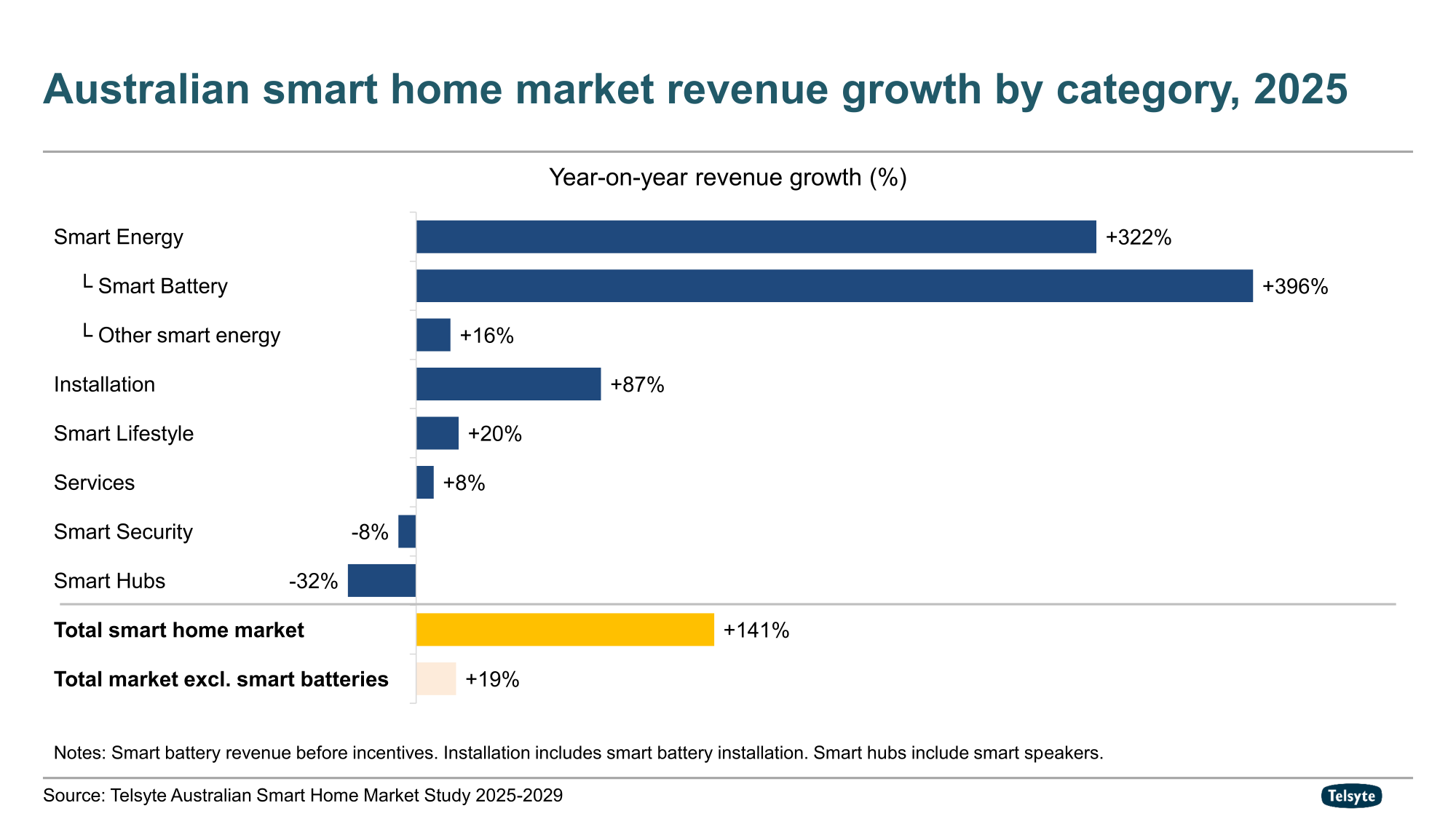
Smart battery systems contributed two thirds of smart home market revenue in 2025 following the launch of the Federal Government’s Cheaper Home Batteries Program, with battery revenue up 396 per cent year-on-year. Excluding smart batteries, the market still grew 19 per cent year-on-year in 2025.
About two in five Australian homes have rooftop solar, and the program has recorded rapid adoption of battery storage in just over 12 months. Telsyte’s research found more than a third of households without solar or battery storage are interested in installing them, indicating the shift towards larger budgets has further potential.
Telsyte expects the battery share to peak in 2026 before moderating to just over half by 2029 under the program's new tiered structure.
More solar power plugging into more EVs
Australia’s expanding solar and battery infrastructure is primed for more electric vehicles (EVs), with Telsyte research finding 37 per cent of non-EV owners would still consider buying one even if fuel prices returned to normal levels.
“Many solar powered homes are taking the next step with batteries and EVs,” Telsyte Managing Director, Foad Fadaghi, says.
Telsyte estimates around half a million EVs will be on Australian roads by the end of 2026, complementing smart battery systems and driving further demand for EV wall chargers and household energy management.
Among solar or battery adopters, 61 per cent are interested in an energy management service, as households accumulate generation, storage, a vehicle charger and a time-of-use tariff that all need to be scheduled against each other. Interest in virtual power plants is also high, reaching 63 per cent among battery owners.
Telsyte also expects the Government's offers like Solar Sharer Offer and Midday Power saver will draw more renters and apartment dwellers into the smart energy market.
Telsyte believes household energy management is becoming the coordinating layer of the smart home, and a sizeable subscription revenue opportunity beyond hardware sales.
Amid the growing complexity, professional installation services remain in high demand, with smart home installation revenue growing 87 per cent year-on-year in 2025, driven by battery installations.
Professional installers' advice is highly valued by 79 per cent of Australians actively looking for ways to make their home smarter, making the trades an increasingly influential channel for product selection.
New smart spaces bring together emerging tech
With smart home products now in most households, consumer attention is turning to specific spaces and outcomes.
The areas Australians most plan to improve with smart home technology are entertainment areas, outdoor living spaces and home offices, while connected products are increasingly used to support wellness, monitoring and comfort as the population ages.
Telsyte forecasts the smart lifestyle segment to grow at 21 per cent CAGR to 2029, the highest of any segment, driven by the growing availability of smart appliances and household robots, including robotic vacuums, window cleaners and lawn mowers.
Smart security adoption continues to rise, led by smart cameras and video doorbells, but revenue declined 8 per cent in 2025 amid increased price competition and demand for products that meet basic monitoring needs with limited smart or AI-enhanced features. Telsyte expects more advanced AI features such as recognising specific people, pets and objects to become the main way vendors compete beyond price, with local storage of recordings helping to address privacy concerns.
AI and user experience the next smart home battleground
As appliance and device makers extend connected features across entire product ranges, from cooking and cleaning to climate, security and energy, Telsyte expects AI-enhanced smart living to appeal to households seeking hyper-personalisation and improved everyday living.
Competition will shift from device specifications to the quality of the experience that ties products together.
Interoperability remains a gap. Among smart home adopters, 67 per cent have had difficulty getting their devices to work together, while only one in seven Australians are currently aware of Matter, the cross-brand standard designed to address it.
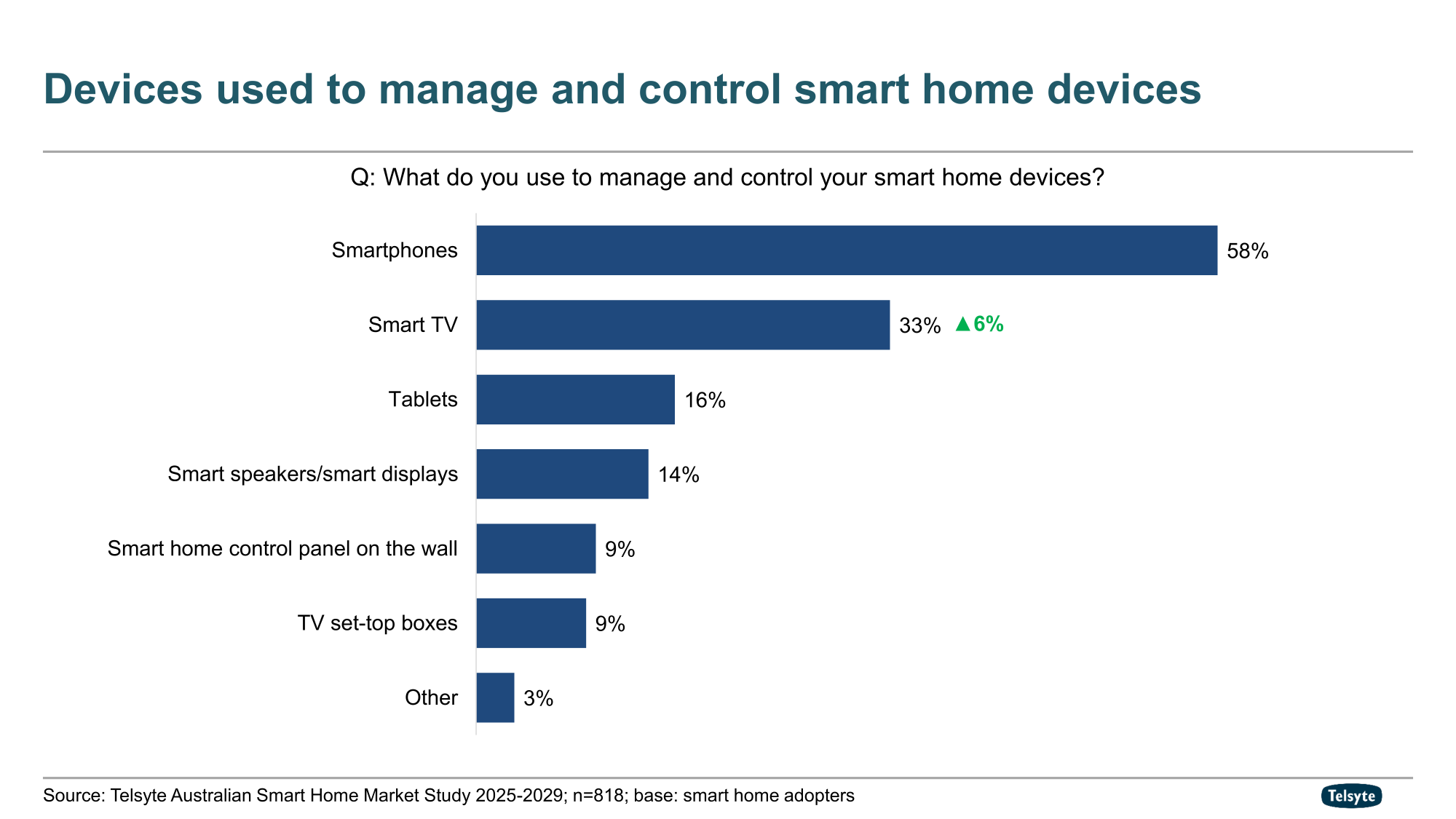
Smartphones remain the dominant smart home controller, used by 58 per cent of smart home users, followed by smart TVs (33%), tablets (16%) and smart speakers and displays (14%).
Revenue from smart hubs, including smart speakers, fell 32 per cent in 2025. Fewer households replaced existing smart speakers, and more smart home products now connect directly via Wi-Fi and apps, reducing the need for standalone hubs. However, Telsyte sees an opportunity for a new generation of shared household interfaces that use more advanced AI to recognise who is in the room and adjust controls, routines and settings to suit that person, beyond the personal smartphone. Apple’s anticipated smart home hub could help revive demand for the category, challenging Google and Amazon, which lead the installed base of smart speakers in Australian homes, with Apple third.
The study found 70 per cent of Australians believe AI could manage a smart home better than they can, up from 58 per cent in 2024, particularly for security, energy, diagnostics and comfort applications.
However, more than three in five would feel uncomfortable if AI made decisions in their home without their prior knowledge, and a similar rate are concerned about AI systems making mistakes.
“Households will hand AI the keys when privacy and security safeguards are in place,” Telsyte Senior Analyst, Alvin Lee, says
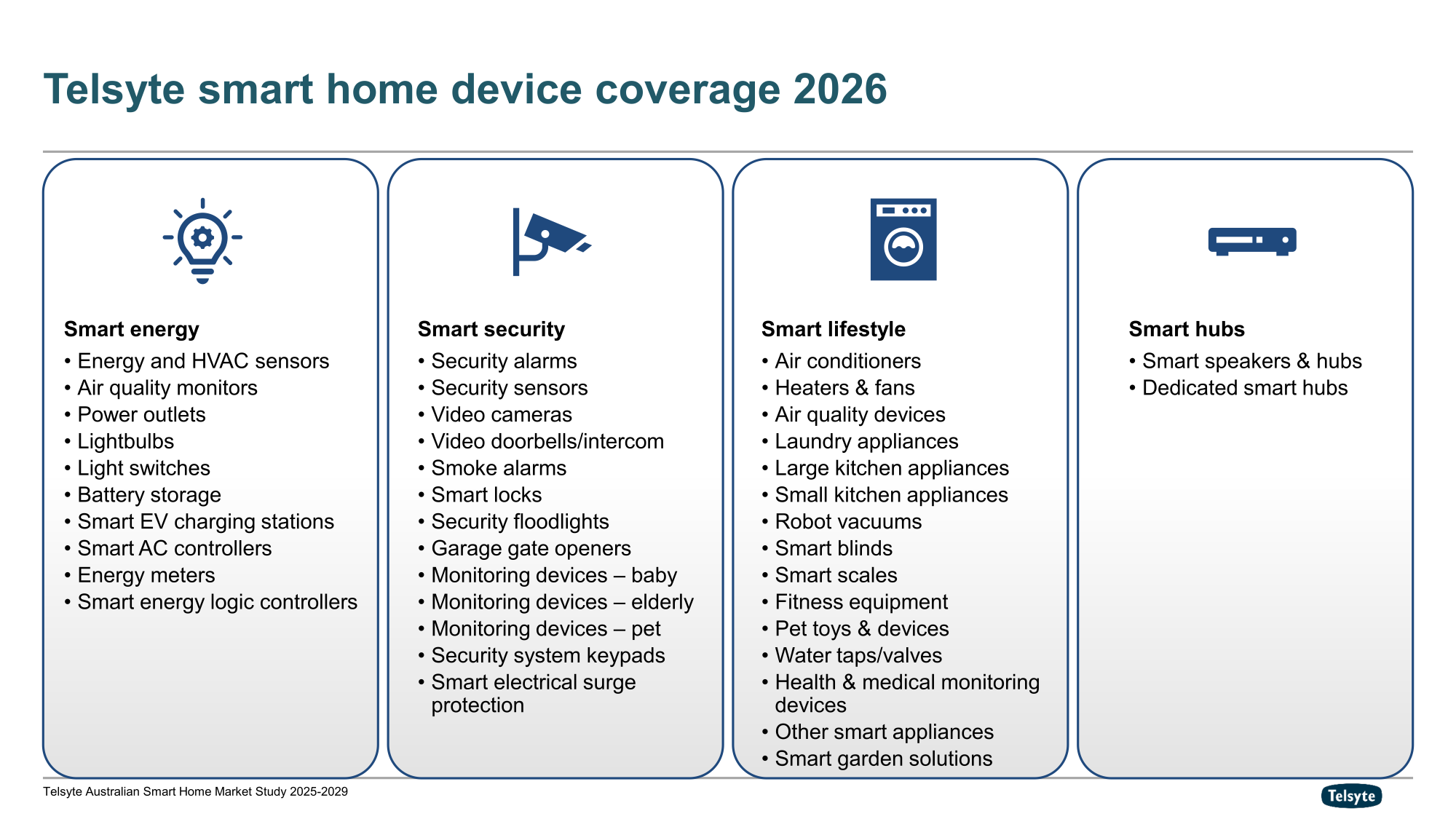
The taxonomy of Telsyte's Australian Smart Home Market Study 2025-2029:
Smart home segments covered:
For further information on the study or media enquiries contact:
Foad Fadaghi
Managing Director
Tel: 1800 313 142
Email: ffadaghi@telsyte.com.au
Alvin Lee
Senior Analyst
Tel: 1800 313 142
Email: alee@telsyte.com.au
The Telsyte Australian Smart Home Market Study 2025-2029 is a comprehensive study which provides subscribers with:
Market sizing and forecasts of the Australian smart home market by detailed segments including services and installation revenues
Insights into consumer attitudes and technology adoption trends
Analysis of vendor strategies and key growth segments
Smart home user profiles, including adopters, those on the verge of adopting and those not yet interested, as well as by their range of budgets.
Analysis of the smart home ecosystems
Analysis of retail and online channels and their importance to smart home products
Insights into where consumers begin their smart home journey and key market drivers expected to drive rapid adoption in different segments.
In preparing this study, Telsyte used:
Telsyte’s Smart Home survey conducted during May and June 2026 with a representative sample of 1,012 respondents, 16 years and older.
Interviews conducted with executives from service providers, network operators, manufacturers, retailers, financial analysts and channel partners.
Financial reports released by manufacturers, retailers and service providers.
Ongoing monitoring of local and global market and vendor trends.
Editor’s note:
Smart battery revenue is calculated before any incentives are applied, including those under the Federal Government's Cheaper Home Batteries Program.
Electric vehicles are not included in Telsyte’s smart home market revenue, but smart EV wall chargers are included.
From 1 May 2026, the Cheaper Home Batteries Program moved to a tiered structure, with the strongest rebate applying to the first 14kWh of capacity and reducing above that. Telsyte expects this to moderate average system size rather than the appetite for storage.
The Solar Sharer Offer is a regulated electricity offer available to eligible households with a smart meter in New South Wales, South Australia and south-east Queensland. Free electricity is capped at 24kWh per day.
Victoria's Midday Power Saver offers free electricity from 11am to 2pm daily to households with a smart meter that opt in through their retailer.
Top home battery brands installed in Australian homes include Alpha ESS, BYD, LG, Sigenergy, Sungrow and Tesla (in alphabetical order).
About Telsyte
Telsyte is Australia’s leading emerging technology analyst firm. Telsyte analysts deliver market research, insights and advisory into enterprise and consumer technologies. Telsyte is an independent business unit of DXC Technology. For more information visit www.telsyte.com.au
The material in this article is copyright protected and not intended to be altered, copied, distributed or used for any commercial or non-commercial purpose, except for news reporting, comment, criticism, teaching and scholarship.