

Apple nears OS parity as component costs set up second-half price rises.
SYDNEY, AUSTRALIA – More than half (56%) of all smartphones sold in Australia in the first half of 2026 were premium devices priced above $1,000, with more than one in five costing above $2,000 (ultra-premium), according to new research from the Australian emerging technology analyst firm, Telsyte.
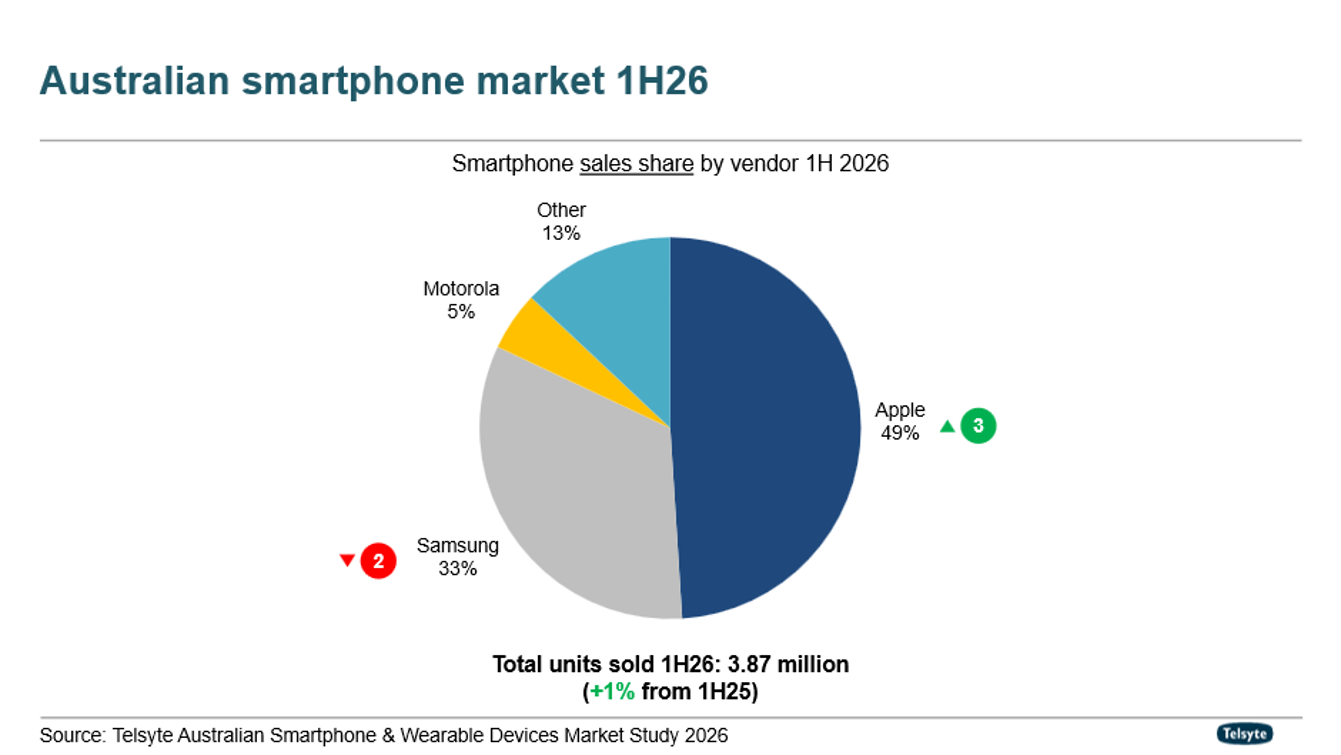
The Telsyte Australian Smartphone & Wearable Devices Market Study 2026 found total smartphone sales reached 3.87 million units in the first half, up one per cent year-on-year, with the premium segment adding 10 percentage points of share over two years.
Apple accounted for almost half (49.4%) of first-half sales, bringing it within reach of Android. iPhone sales rose seven per cent while Android volumes fell five per cent year-on-year, with the weakness concentrated in sub-premium handsets and premium Android volumes still growing.
Telsyte believes some iPhone buyers have brought upgrades forward amid reported expectations of component-driven price increases. Apple, Samsung and Motorola are the top three vendors, with Motorola and Oppo separated by a slim margin having traded third and fourth positions several times over the past two years.
The first-half result was also driven by inventory brought into the market ahead of rising memory and component costs, which has kept retail pricing broadly stable and insulated buyers from underlying movement. Telsyte believes that buffer is thinning, and that stock replenished at current prices will bring more widespread increases through the second half of 2026.
Telsyte forecasts 8.4 million smartphones will be sold in Australia in 2026, down three per cent year-on-year, with the decline weighted towards the second half as memory-driven cost increases are reflected more broadly across the device range. Demand is expected to remain concentrated in the premium tier, supported by consumer intent to future-proof the next device and treat it as a long-term investment.
Australia's average smartphone replacement cycle has shortened to 3.4 years, down from a peak of 3.9 years at the end of 2023. The decline is most pronounced among Android users, whose cycle has compressed by 0.7 years compared with 0.4 years among iPhone users, reflecting the concentrated impact of the 2024 3G network closure on lower-cost handsets.
Budget users now hold their devices twice as long as ultra-premium buyers, concentrating the most commercially active upgraders at the top of the market. That segment is the primary audience for premium devices, on-device AI and next-generation form factors such as foldables. Apple and Samsung lead the premium and ultra-premium tiers, where competition from brands including Oppo, Google, Motorola, Nothing and Honor is intensifying as more players push upmarket.
Despite persistent cost-of-living pressure and the increasing popularity of refurbished phones, Telsyte research found 85 per cent still prefer to purchase a new device, managing affordability by choosing last year’s flagship models or switching brands.
Over 11 million Australians are using device-integrated AI features on their smartphones, from writing assistance and photo editing to live translation, making the smartphone the most widely adopted AI device in the country. Only one in three, however, say their next smartphone must include advanced AI features, with battery life, performance and storage remaining the dominant considerations. While 58 per cent are willing to allow AI access to selected apps and information on their device, only 21 per cent are comfortable with AI suggesting actions without being asked.
Foldables gaining traction, an Apple entry would ignite foldable market
The study found foldable smartphones now account for approximately five per cent of annual smartphone sales, but are yet to cross into the mainstream. Telsyte believes an Apple foldable (expected in 2026) will be the single largest catalyst for the category.
Consumer appetite for an Apple foldable is high with one third of iPhone users would consider a foldable iPhone, rising to nearly half (46%) among users of the iPhone 15, 16 and 17 Pro series. One in six (17%) of those Pro series users would pay $3,000 or more, placing early demand squarely in the segment that already spends the most.
If Apple launches a foldable iPhone in 2026, Telsyte believes it could become the second largest foldable vendor in Australia within its first year, assuming supply is not constrained.
Telsyte estimates a price premium of 30 to 40 per cent above the iPhone Pro Max, placing the device in the ultra-premium tier, the strongest growth segment in the market today. Samsung is expected to retain the lead with its broadest line-up yet, including a newly designed passport-style Galaxy Z Fold 8.
iPhone users are evenly split between the larger, taller book-fold style and the more compact flip, against a clearer preference for the book-fold format among Android users (58%).
“Despite the potential lofty prices, a new foldable iPhone could finally propel the category into the mainstream” Telsyte principal analyst Foad Fadaghi says.
Ecosystem wearables deepen as smart glasses emerge
More than 800,000 smart wrist wearables were sold in the first half of 2026, down eight per cent year-on-year as the category matures and budgets tighten. Apple, Samsung and Garmin lead, with smartwatches accounting for more than 70 per cent of sales. Demand is now driven by ecosystem lock-in, fitness and health sensing upgrades and deeper assistant integration.
Smart ring adoption remains embryonic, with fewer than five per cent of Australians owning one and Samsung leading the category. Interest sits at just over a quarter (29%), reflecting the fitness and health tracking wrist wearables already deliver to a far larger installed base.
Smart hearables sales reached more than 1.2 million units over the same period, up 16 per cent year-on-year, driven by new product releases, bundling and a more affordable upgrade path than other personal devices. Close to half (48%) of users wear their devices daily and more than a quarter use voice features every day, making hearables a natural companion to on-device AI.
Smart glasses adoption is equally embryonic, though interest runs well ahead of smart rings, with two thirds (66%) saying they would consider one. More than two thirds of current owners wear Meta's AI glasses, including Ray-Ban and Oakley branded models. The most sought-after features are hands-free photo and video capture (28%), real-time information about what they see (23%) and reduced phone usage (22%).
"AI is moving from something Australians open to something they wear," says Telsyte Senior Analyst Alvin Lee.
Telsyte expects sub-$100 glasses and premium ecosystem entrants to broaden the category over the next twelve months, though social and privacy concerns are likely to persist. Nearly half (47%) of Australians say they would feel self-conscious wearing smart glasses in public, and only 30 per cent are comfortable with people around them regularly wearing camera-equipped smart glasses.
For further information on the study or media enquiries contact:
Foad Fadaghi
Managing Director
Tel: 1800 313 142
Email: ffadaghi@telsyte.com.au
Alvin Lee
Senior Analyst
Tel: 1800 313 142
Email: alee@telsyte.com.au
The Telsyte Australian Smartphone & Wearable Devices Market Study 2026 is a comprehensive study that provides subscribers with:
Smartphone market sizing estimates, platform and vendor market shares and forecasts
Smart wrist-based wearables market sizing estimates, platform and vendor market shares and forecasts
Smart hearables market sizing estimates, platform and vendor market shares and forecasts
End user trends across devices, application usage, platforms and operators
Purchase intentions and acquisition channels
Strategic analysis of recent market trends and developments
In preparing this study, Telsyte used:
An online survey conducted in April and May 2026 with a representative sample of 2,023 respondents, 16 years and older.
Interviews conducted with executives from service providers, network operators, manufacturers, retailers, financial analysts and channel partners.
Financial reports released by service providers, manufacturers and retailers.
On-going monitoring of local and global market and vendor trends.
Analyst reviews of leading smartphone and wearable devices.
Telsyte measures smart wearables as:
Smart wrist wearables: worn on a user’s wrist typically paired and controlled via a smartphone. Examples include products from Apple, Fitbit, Fossil, Garmin, Google, Huawei, Oppo, Samsung, Polar, Ryze, SPACETALK, Withings and others.
Smart hearables: smart earbuds and headphones that support digital assistant and typically paired with a smartphone. Examples include Apple Airpods, Samsung Galaxy Buds, Google Pixel Buds, Oppo Enco Clip2, JBL Reflect Flow Pro+, Jabra Elite, Bose QuietComfort® 45, and Sony LinkBuds.
Telsyte covers smartphones from Apple, ASUS, CAT®, Google, HMD, Honor, Motorola, Nokia, Nothing, Opel, OPPO, Samsung, TCL, Xiaomi, ZTE and others.
Editor’s note:
Telsyte's replacement cycle is calculated from the gap between each respondent's two most recent smartphone purchases, reflecting completed replacement behaviour rather than stated forward intent.
Telsyte measures sales of devices (“sell out”), not shipments or sales to retailers or carriers (sometimes called “sell-in”). Telsyte believes this is a more accurate measure of performance of products in a marketplace. Telsyte does not rely on disclosure from vendors or general assumptions made for large multinational companies that do not release local market data. Telsyte uses a comprehensive methodology that includes surveys of consumers, discussions with vendors, carriers and their partners, retailers, and financial analysts. In addition, public financial results from manufacturers and carriers are used. Telsyte tests a wide range of products in real life usage scenarios and conducts satisfaction and repeat purchase surveys with large and representative samples of Australian smart device users. Telsyte is a pioneer in measuring and reporting smartphone sales in Australia and has been providing insights on mobile technologies since 2006.
Device-integrated AI refers to artificial intelligence capabilities built directly into consumer devices. Examples include Apple Intelligence, Samsung Galaxy AI, Gemini on Google Pixel devices, Moto AI and Oppo AI.
About Telsyte
Telsyte is Australia’s leading emerging technology analyst firm. Telsyte analysts deliver market research, insights and advisory into enterprise and consumer technologies. Telsyte is an independent business unit of DXC Technology. For more information visit www.telsyte.com.au
The material in this article is copyright protected and not intended to be altered, copied, distributed or used for any commercial or non-commercial purpose, except for news reporting, comment, criticism, teaching and scholarship.