

SVOD reaches 28 million services as BVOD, creator content and microdramas compete for viewing time
SYDNEY, AUSTRALIA – Australia’s subscription entertainment market grew by 5 per cent to 57.6 million services in the 12 months to June 2026, according to new research from the Australian emerging technology analyst firm, Telsyte.
The Telsyte Australian Subscription Entertainment Study 2026 found the market is maturing, with growth continues across the three main categories of SVOD (5%), streaming music (6%), and games-related subscriptions (4%).
Ads and deals carry SVOD to 28 million
More affordable ad-supported plans, deals, cross-sector bundles and the inclusion of more sport lifted Subscription Video on Demand (SVOD) services to 28.0 million by June 2026, up 5 per cent year-on-year.
This marks the fourth consecutive year of single-digit growth since the market last expanded by double digits in FY2022. Ad-supported subscriptions climbed 11 per cent to 7.1 million, accounting for 52 per cent of the total net increase, while ad-free subscriptions grew about 3 per cent.
Paid subscriptions increased by 5 per cent over the same period, while non-paying subscriptions rose 17 per cent, driven by free trials and partner offers ranging from telco and utility bundles to rewards redemption. Paid subscriptions account for 94 per cent of the total.
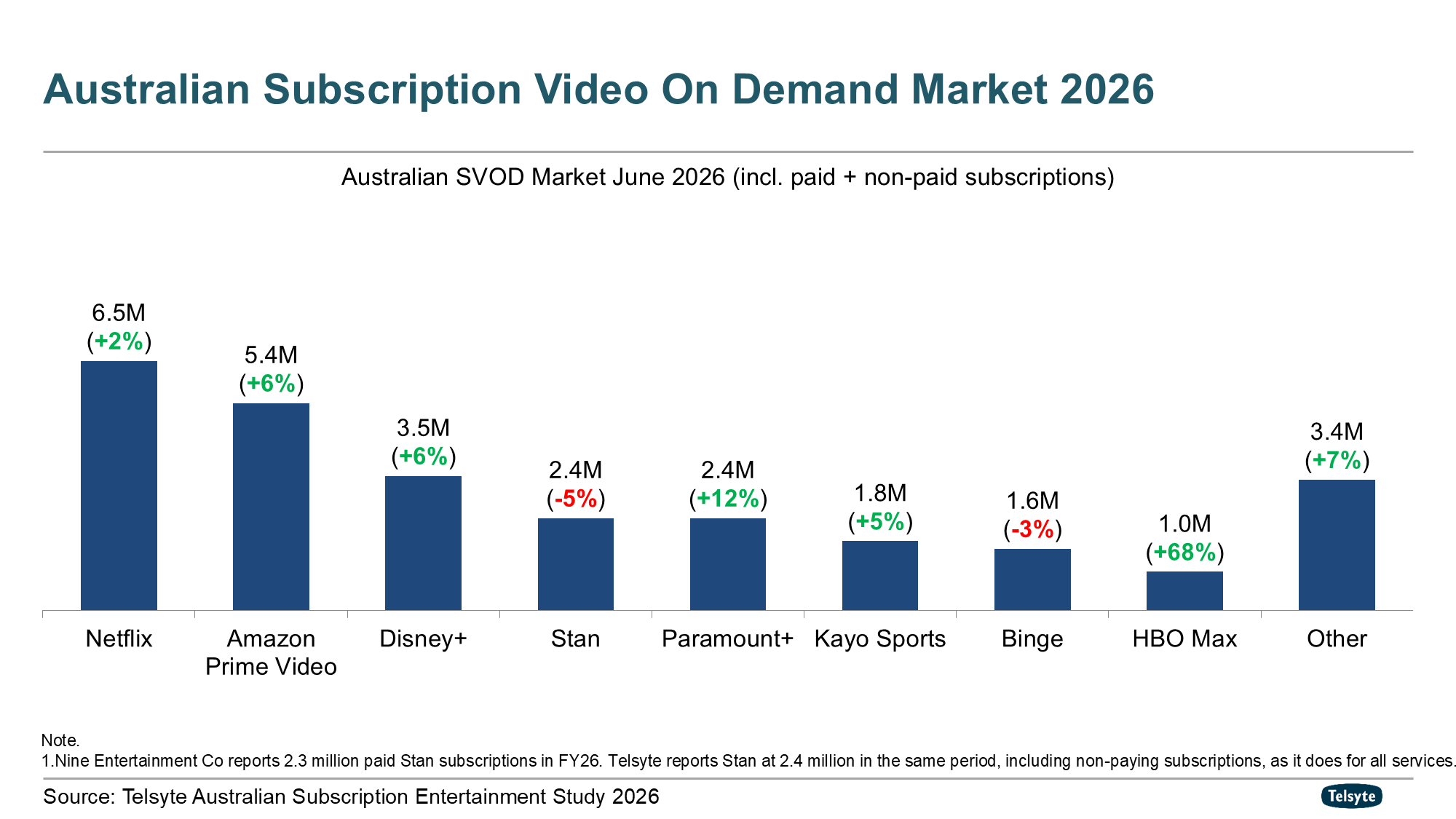
The order of market leaders was unchanged with Netflix (6.5 million) holding the top position, followed by Amazon Prime Video (5.4 million); Disney+ (3.5 million); Stan (2.4 million); Paramount+ (2.4 million); Kayo Sports (1.8 million); Binge (1.6 million); and HBO Max (1.0 million). HBO Max was the fastest-growing major service in FY2026 following its launch in March 2025.
The long tail of services with fewer than one million subscriptions collectively grew by 7 per cent, with genre specialists Crunchyroll (anime) and Hayu (reality) growing fastest.
Streaming holds its place in the household budget
Telsyte found the average monthly budget among those willing to pay for streaming video services rose 4 per cent to $43.5, in line with inflation and well below the 18 per cent jump a year earlier, even as six of the top ten SVOD services raised prices during FY2026.
Some 12 per cent of households cut back on SVOD spending in the past year. However, paid SVOD services rank 12th among Telsyte’s 23 tracked areas of reduced household spending, down from 10th a year ago. Dining out and takeaway, clothing and accessories, groceries and holiday spending lead the list.
Most subscribers (71%) notice when a service they pay for raises its price, yet more than a third of Australians (36%) say entertainment subscriptions are among the last things they would cut from their household budget.
Telsyte Principal Analyst Foad Fadaghi says the market is under increasing pressure, with household streaming budgets flat in real terms pushing providers to lean on advertising and deals to sustain growth.
“Cutting streaming services simply does not impact household budgets like bigger ticket items such as whitegoods, travel and eating out,” says Fadaghi.
The wider availability of ad-supported plans is giving consumers more choice within their budgets, with Disney+ adding an ad tier in April 2026. Amazon Prime Video and Netflix hold the largest ad-supported subscriber bases. Half (51%) of SVOD subscribers say what they save on an ad-supported plan is worth putting up with the ads, rising to 58 per cent among those with three or more services.
Deals are also appealing, with around a quarter of SVOD subscribers encountering offers in the past year including cross-sector partnerships spanning telecom, utilities, financial services and other sectors. Most acted on them, securing an average 39 per cent discount for three months.
Some 41 per cent of SVOD subscribers say they rotate between services more than they did a year ago to manage costs, down from 46 per cent in 2025, and subscribing households held steady at 3.3 services on average.
“Ad-supported plans are where subscribers land when budgets tighten. Any price rise from here could see subscribers walk away,” says Telsyte Senior Analyst Alvin Lee.
Creators rival the streamers as microdramas reach one in four Australians
In addition to paid SVOD, free and ad-supported services remain a critical part of Australians’ video entertainment mix.
Telsyte found average weekly video consumption held steady at around 51 hours. Broadcast Video on Demand (BVOD) recorded the largest gain, up 0.9 hours a week, with YouTube also edging up, while SVOD viewing eased 0.6 hours even as SVOD subscriptions grew 5 per cent. Viewing time across other categories was largely unchanged.
Each of the five main BVOD services (7plus, 9Now, 10, ABC iView and SBS On Demand) reached at least 12.9 million viewers over the past year, helped by major events such as the Winter Olympics and the FIFA World Cup.
Free ad-supported streaming TV (FAST) services reached 2.4 million users, up 4 per cent after growing more than 40 per cent the previous year, led by Samsung TV Plus and LG Channels.
Social media video platforms such as YouTube and TikTok continue to attract mainstream audiences, with 18 million Australians watching YouTube. Half of them are doing so daily, drawn mainly by creator-led and user-uploaded videos.
The research found 5.7 million Australians paid for creator ‘member’ subscriptions on platforms such as YouTube, Twitch, X and Patreon in the past 12 months.
“The creator economy in Australia in aggregate has as many paying subscribers as major streaming providers,” says Fadaghi.
Microdramas, an emerging format of short, serialised dramas shot vertically for phone screens with episodes typically running a few minutes, have already reached one in four Australians (26%) in the past 12 months.
Telsyte research found that when Australians have ten minutes to fill, close to half (46%) turn to social media or YouTube. Microdramas extend scripted storytelling into those short phone sessions, a slot long-form video is less suited. Telsyte expects the format to take a growing share of viewing time, as it has overseas.
Sport draws SVOD sign-ups
The increasing inclusion of sport is also driving growth, with more than one in five (23%) subscribers to Australia’s top SVOD services (excluding dedicated sport service Kayo) citing sport as a key reason for signing up, as general entertainment services add more live sport to their line-ups.
The study found three in five (61%) Australians say major national sporting events should remain free to watch, even if other sport content is paid, in line with Australia’s anti-siphoning rules.
Half (50%) of SVOD subscribers say it is important for streaming services to carry content that represents Australian stories, voices, culture and values, down from 58 per cent in 2025, as major streaming services begin meeting new local content investment obligations. Telsyte believes the cost of living and rising subscription prices might have weighed on this result.
Even so, more SVOD subscribers having seen Australian-related programming than other content, with working and everyday Australian life (40%) and regional and remote Australia (31%) lead the stories subscribers most want to see on screen.
Streaming music subscriptions steady on
Streaming music reached 20 million subscriptions at the end of June 2026, up 6 per cent from previous year, supported by population growth and bundled access. Half (50%) of music streamers say access to their services are essential, up from 44 per cent a year ago.
Spotify, Google (including YouTube Music and YouTube Premium listeners for music) and Apple Music remain Australia’s top streaming music providers.
Bundled play lifts games-related subscriptions as hardware costs bite
Australians held 10 million games-related subscriptions at the end of June 2026, up 4 per cent year-on-year, driven by Netflix Games as it expands from mobile to TV and computer. Excluding Netflix Games, subscriptions declined 2 per cent as price rises for subscriptions and gaming hardware weighed on demand.
For further information on the study or media enquiries contact:
Foad Fadaghi
Managing Director
Tel: 1800 313 142
Email: ffadaghi@telsyte.com.au
Alvin Lee
Senior Analyst
Tel: 1800 313 142
Email: alee@telsyte.com.au
The Telsyte Australian Subscription Entertainment Study 2026 is a comprehensive study which provides subscribers with:
Market sizing and forecasts of the Australian entertainment subscriptions market, including video, music and games
Insights into consumer attitudes and technology adoption trends
Uptake, intention and detailed analysis of
Video services including: SVOD, pay TV/IPTV, BVOD and FAST services
Streaming audio-related services
Games-related subscription services
Service and content consumption preferences
Insights into the future of entertainment subscription services in Australia.
In preparing this study, Telsyte used:
An online survey conducted in August and September 2026 with a representative sample of 1,025 respondents, 16 years and older.
An online survey conducted in April and May 2026 with a representative sample of 2,023 respondents, 16 years and older.
Interviews conducted with executives from SVOD, Pay TV/IPTV and video game service providers, content providers, funding agencies and hardware manufacturers.
Financial reports released by service providers and media companies.
On-going monitoring of local and global market trends.
Editor’s note:
Telsyte’s measurement includes both paid and non-paying subscriptions.
Where a subscription bundles services across categories, Telsyte measures each service as a subset of the parent subscription, based on subscribers’ self-reported use (for example, Amazon Prime Video and Amazon Music within Amazon Prime, and Netflix Games within Netflix). As a result, category figures for subscription video, music and games do not add up to the market total, in which each subscription is counted only once.
Nine Entertainment Co reports 2.3 million paid Stan subscriptions in FY2026. Telsyte reports Stan at 2.4 million in the same period, including non-paying subscriptions, as it does for all services.
Stan launched its ad-supported tier in August 2026; it is not included in the FY2026 ad-supported subscription measurement.
Telsyte actively monitors the SVOD services market, including over 40 SVOD services. Other examples include Apple TV+, BritBox, beIN Sports, Crunchyroll, Foxtel Now, Hayu, NBA League Pass and etc.
The measure is the number of subscriptions at the end of June 2026 (snapshot), not usage/utilisation. Content releases will influence the number of subscriptions when measured at different points in time.
Telsyte measures the hours that consumers spend on consuming all types of video content. Examples include FTA TV, SVOD, Pay TV, social media videos, BVOD, FAST services etc.
Examples of FAST services include Samsung TV Plus, LG Channels and Plex.
Payment made to directly support individual creators excludes adult content.
Microdramas are short, serialised dramas, typically filmed in vertical format with episodes of a few minutes or less, distributed through social platforms and dedicated apps such as ReelShort and DramaBox. Local media companies have begun testing short vertical formats, including Nine’s microreality series Flex.
About Telsyte
Telsyte is Australia’s leading emerging technology analyst firm. Telsyte analysts deliver market research, insights and advisory into enterprise and consumer technologies. Telsyte is an independent business unit of DXC Technology. For more information visit www.telsyte.com.au
The material in this article is copyright protected and not intended to be altered, copied, distributed or used for any commercial or non-commercial purpose, except for news reporting, comment, criticism, teaching and scholarship.