
Rapid adoption meets rising caution as AI advertising tests consumer trust
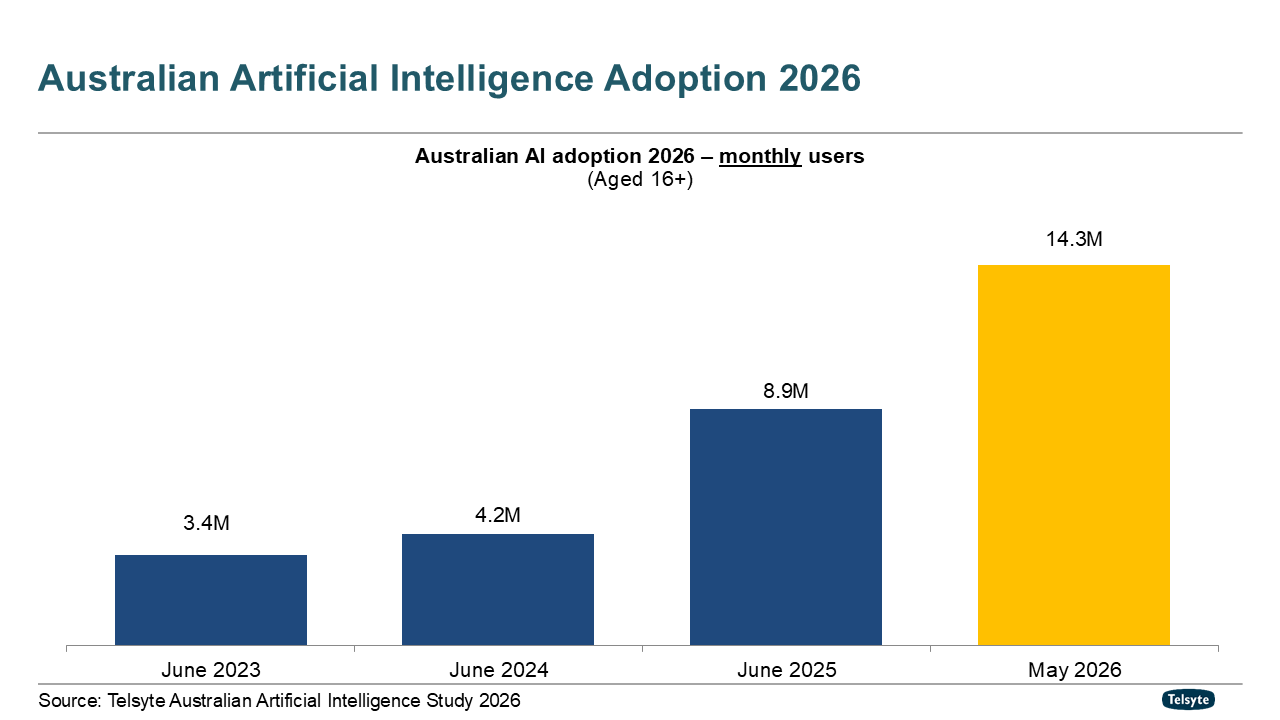
SYDNEY, AUSTRALIA – Artificial intelligence has become part of everyday life for 17.4 million Australians (77% of the 16+ population), as the national user base grew by more than 6 million from June 2025 to May 2026, according to new research from Australian emerging technology analyst firm Telsyte.
The Telsyte Australian Artificial Intelligence Study 2026 found engagement has deepened sharply alongside adoption. Of the AI user base, four in five (14.3 million) engaged with AI at least monthly, up 61 per cent year-on-year – including 5.2 million who now use it every day, a 160 per cent surge from approximately 2 million in June 2025.
More than a third (35%) of users say they are using AI significantly more than a year ago, and nearly half (48%) report improved proficiency with AI tools over the same period.
ChatGPT leads as the competitive field widens
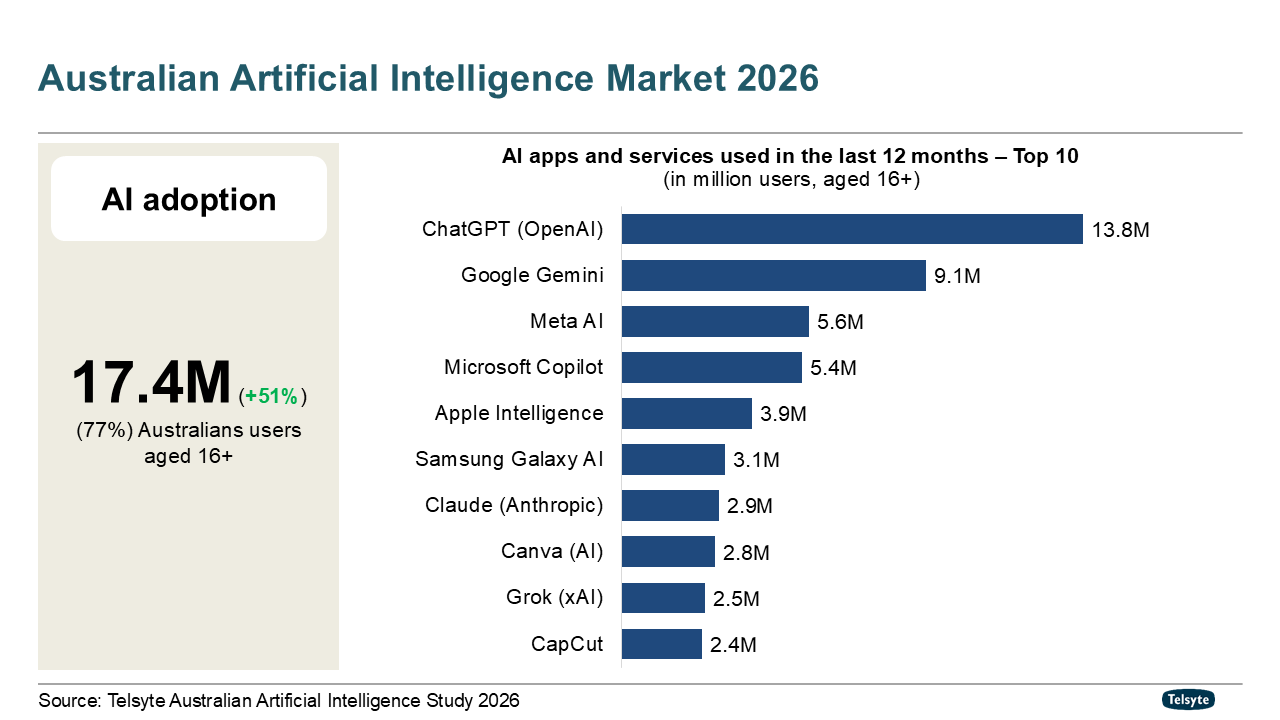
ChatGPT retains dominant market position with 13.8 million users, followed by Google Gemini (9.1 million), Meta AI (5.6 million) and Microsoft Copilot (5.4 million). The top 10 is completed by Apple Intelligence (3.9 million), Samsung Galaxy AI (3.1 million), Claude (2.9 million), Canva AI (2.8 million), Grok (2.5 million) and CapCut (2.4 million).
Typing remains the dominant mode of AI interaction at 80 per cent compared with 20 per cent using voice, a gap Telsyte believes points to potentially significant runway for voice-driven AI experiences in smart home and in-vehicle environments (e.g. Android Auto, Apple CarPlay and Grok on newer Tesla models).
More than one in five AI users now use five or more services, a figure that nearly doubles among daily users. Telsyte believes service rotation is increasingly driven by use cases and free-tier limits, with standalone AI services facing more loyalty risk than those anchored within established platform ecosystems.
Search goes agentic as trust and advertising pressure converge
While AI is growing rapidly, it is doing so against a backdrop of consumer anxiety about pace and a foundational trust deficit that the industry has yet to resolve. The study finds 62 per cent of Australians feel technology is changing faster than they can keep up with, while just 35 per cent trust technology companies to use their data responsibly. These are foundational constraints that now directly bear on how AI providers monetise their growth.
The majority of AI users remain on free tiers and advertising is emerging as a way for AI service providers to generate revenue, with OpenAI already testing ads within ChatGPT in Australia and the United States.
Australians are broadly open to the concept, as 70 per cent would opt for a free, ad-supported service over a paid, ad-free alternative - yet only 27 per cent are comfortable seeing ads within AI-generated answers, and more than half (52 per cent) believe sponsored AI answers are less trustworthy than organic responses.
AI has reached the majority of Australians faster than almost any consumer technology before it, yet trust in the technology has not kept pace. Telsyte Principal Analyst Foad Fadaghi says advertising as a revenue model only sharpens that tension.
"If it erodes confidence in AI-generated answers, it cuts against the fundamental value proposition. That is a difficult trade-off to walk back."
The study also finds 12 per cent of Australians now identify AI tools as their primary means of finding information online, up from 5 per cent a year ago. Majority (81%) are aware of AI summaries in search results, with half indicating they would often rely on the summary without clicking through to the source.
Telsyte anticipates these shifts will pressure search, publishing and digital marketing models as AI summaries and agentic search experiences become more common.
For a market where Google remains the dominant search entry point, the implications for advertisers and publishers are immediate. E-commerce and retail sites are primed to retool content for machine consumption as AI agents increasingly guide product discovery and purchasing.
AI-native hardware finds its footing as the agent-first era takes shape
The smartphone remains the primary AI device, used by 78 per cent of AI users compared with 58 per cent accessing AI on computers. Built-in everyday features such as writing assistance, live translation and AI-assisted photo editing have made AI a natural and largely frictionless part of the smartphone experience. However, Telsyte notes that more demanding use cases – such as complex workflows, coding and locally run AI agents -continue to favour computer systems with greater processing capability.
AI on smartphones and other devices is moving beyond responding to prompts - anticipating needs, acting on context and executing tasks without being asked.
Over a quarter (27%) of Australian AI users have already used AI to complete tasks on their behalf - from product comparisons and inbox management to scheduling and online shopping - marking the early stages of agentic AI in practice. However, currently only 31 per cent said they are comfortable with AI playing a larger role in managing their everyday activities.
For anticipatory and agentic AI to work, devices need access to the personal data that makes contextual awareness possible. Australians are most comfortable granting access to calendar (32%), location (26%) and email (24%), with comfort dropping sharply for more sensitive categories including cloud storage, personal notes and payment methods - none above 12 per cent.
Willingness to delegate to AI comes with conditions. Nearly two in five (39%) would allow AI to complete tasks provided they approve the final step, rising to 66 per cent among daily users. Privacy (62%), account security (59%) and fear of AI making mistakes (49%) are the primary reasons full autonomy currently remains off the table.
Despite the breadth of adoption, AI capability is not yet a primary hardware purchase driver. Only one in three Australians say their next smartphone or computer must include advanced AI features. Fundamental device attributes such as battery life and performance remain the dominant purchasing considerations, reflecting the market currently dominated by cloud-based AI services.
Two in five AI users (41%) are interested in devices from AI-native companies such as OpenAI, Anthropic or xAI, rising to 66 per cent among daily users - marking an early appetite for purpose-built AI hardware. Around one in ten are already running AI agents on a dedicated device, and among those who chose a computer for this purpose, more than 40 per cent opted for Apple silicon, a share considerably above Mac's overall market share in Australian households.
"Despite the anticipation around AI-native hardware, existing form factors like smartphones and wearables are where mass AI adoption will happen," says Telsyte Senior Analyst Alvin Lee.
Cost-of-living crunch meets AI boom as 8 million gig workers work smarter
The study found the gig and sharing economy market has grown 65 per cent from 2024 to nearly 8 million Australians in 2026, at a time when 58 per cent of Australians say they feel more financially stretched than a year ago.
The growth is more concentrated in content creation and software programming, two areas where AI tools have materially lowered the barrier to entry and expanded individual output capacity.
AI is also playing a central role in how this workforce operates. The study found 75 per cent of gig and independent workers use AI tools at least weekly, well above the 66 per cent average across the broader user population.
Three in five (61%) say AI has enabled them to accomplish tasks previously beyond their reach, a result Telsyte regards as evidence of AI's role as a genuine enabler of economic participation for this segment.
Telsyte notes, however, that two-thirds of gig workers describe these earnings as supplementary rather than primary income, a distinction that is important context when assessing AI's net impact on household financial security.
For further information on the study or media enquiries contact:
Foad Fadaghi
Managing Director
Tel: 1800 313 142
Email: ffadaghi@telsyte.com.au
Alvin Lee
Senior Analyst
Tel: 1800 313 142
Email: alee@telsyte.com.au
The Telsyte Australian Artificial Intelligence Study 2026 is a comprehensive study which provides subscribers with:
The state of the Australian Artificial Intelligence market, including adoption trends across standalone AI services and device-integrated AI
Uptake, intention and detailed analysis of leading AI services. Over 40 top services measured
Usage intensity analysis across daily, weekly and monthly users
Consumer attitudes toward AI advertising, data privacy and trust, and others in relation to AI
Analysis of AI search behaviour and its implications
Insights into agentic AI adoption, task delegation behaviour, personal data access preferences and appetite for AI-native hardware
The state of Australia’s gig and sharing economy market and participant trends
In preparing this study, Telsyte used:
An online survey conducted between April and May 2026 with a representative sample of 2,023 respondents, 16 years and older.
Interviews conducted with executives from hardware manufacturers and content providers.
Financial reports released by service providers and hardware manufacturers.
On-going monitoring of local and global market trends.
Editor’s note:
Telsyte’s measure of AI adoption include dedicated services and AI features integrated directly into devices. Device-integrated AI refer to artificial intelligence capabilities built directly into consumer devices. Examples include Apple Intelligence, Samsung Galaxy AI, Gemini on Google Pixel devices, Moto AI and Oppo AI.
Apple has officially opened Apple CarPlay to third-party conversational AI assistants with its iOS 26.4 release, with ChatGPT and Perplexity already available and others expected to follow. Google's Gemini is already integrated into Android Auto, while Grok is available in newer Tesla models.
Examples of proactive and anticipatory on-device AI features include recognising a friend's message about holiday photos and opening the camera roll directly, or nudging a user toward the calendar while composing a meeting note, consolidate notifications, messages, emails, travel bookings and personal habits into proactive daily briefs. Example of more advanced agentic features such as: a prompt to "book a taxi to the airport" sees AI open the app, fill the details and present the confirmation for a single tap of approval.
Gig and sharing economy work is defined by Telsyte as income-generating activities outside traditional employment, spanning platform-based gig work, freelancing, digital content creation, small business activity and asset-sharing income. This market represents individuals leveraging digital platforms, skills or assets for flexible income generation.
About Telsyte
Telsyte is Australia’s leading emerging technology analyst firm. Telsyte analysts deliver market research, insights and advisory into enterprise and consumer technologies. Telsyte is an independent business unit of DXC Technology. For more information visit www.telsyte.com.au
The material in this article is copyright protected and not intended to be altered, copied, distributed or used for any commercial or non-commercial purpose, except for news reporting, comment, criticism, teaching and scholarship.